

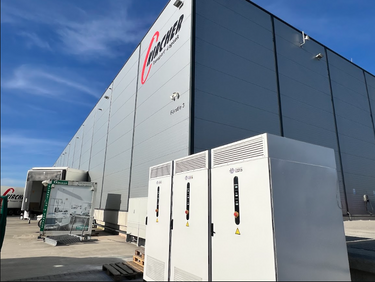
Battery Storage for Grid Congestion in the Netherlands: A Practical Guide for C&I Projects
Grid congestion is becoming a practical constraint for Dutch businesses planning electrification, EV charging, solar PV or capacity expansion. Battery energy storage can help businesses make better use of their available grid capacity by managing when electricity is imported, stored and used.
However, installing a larger battery does not automatically solve grid congestion. For C&I projects, the BESS needs to be sized around the site's grid limit and load profile, while its EMS must coordinate charging and discharging to keep grid demand within the required limit.
For installers and EPCs, the right BESS starts with the grid constraint and load profile, then determines the required power, usable energy, EMS strategy and project economics.
How Battery Storage Helps Dutch Businesses Manage Grid Congestion
For many C&I projects, the relevant grid-congestion challenge is a power constraint: the site needs to import or export more power than its grid connection can accommodate during certain periods.
A BESS can help manage this constraint by reducing the site's peak grid demand. When electricity consumption approaches the permitted grid-import limit, the battery discharges to supply part of the load. This is commonly known as peak shaving.
Consider a hypothetical business with a 500 kW permitted grid-import limit and an 800 kW peak demand lasting two hours. The required peak reduction would be:
800 kW − 500 kW = 300 kW
If the BESS must provide 300 kW throughout the two-hour peak, the theoretical usable-energy requirement is:
300 kW × 2 h = 600 kWh
This illustrates a fundamental BESS sizing principle:
BESS power determines how much of the peak can be covered; usable energy determines how long the battery can provide that support.
The 600 kWh represents the theoretical usable-energy requirement, not necessarily the battery's nominal capacity. Final installed capacity must also account for the allowable SOC range, conversion losses, operating reserves, degradation and required end-of-life capacity.
RVO identifies battery storage as one potential option for businesses dealing with grid congestion, particularly where high electricity peaks, renewable generation or business expansion create additional capacity needs.
How to Size a BESS for Grid-Constrained Operations
BESS sizing should start with the customer's load profile and grid connection limit, rather than a predefined battery size.
The preliminary sizing logic is:
Required BESS power = Site peak demand − permitted grid import
Required usable energy = Required BESS power × required support duration
In practice, these calculations should be based on high-resolution load data. Installers and EPCs should analyze when, how often and for how long the site exceeds its available grid capacity, using the highest-resolution data available, preferably 15-minute data or better.
A 300 kW peak lasting 15 minutes requires a very different battery configuration from a 300 kW peak lasting four hours. The objective is therefore not simply to match annual electricity consumption, but to determine the power and usable energy required to keep grid demand within the permitted limit.
Final sizing should also account for the usable energy window, SOC limits, PCS and system losses, operating reserves, battery degradation and expected future loads. Planned EV charging, production expansion or other high-power equipment can materially change the site's future demand profile.
A reliable BESS design is based on peak demand and duration—not annual electricity consumption or nominal battery capacity alone.
Why EMS and Multi-Use Applications Matter
Battery capacity alone does not solve grid congestion. The Energy Management System (EMS) determines when the BESS charges and discharges and coordinates its operation with site demand, PV generation, EV charging and the available grid capacity.
For example, if a site has a 500 kW grid-import limit, the EMS can monitor grid power and discharge the BESS when demand approaches that threshold. Charging must also be carefully scheduled. If the battery charges from the grid during a constrained period, it could increase grid demand rather than reduce it.
The same BESS can potentially support other applications, including PV self-consumption, EV charging and electricity-price optimization. Where applicable, flexibility services may provide an additional revenue or cost-saving opportunity.
However, these applications compete for the same limited power, energy capacity and state of charge (SOC). If the battery needs to reserve energy for peak shaving later in the day, that energy may not be available for another application at the same time.
A multi-use BESS therefore needs an EMS strategy that prioritizes the site's grid constraint while allocating available battery capacity to applications that create additional value.
How to Evaluate the Economics of a Grid-Constrained BESS
The technical ability to reduce grid demand does not automatically make a BESS financially attractive. The business case depends on how much operational value the battery can generate compared with its lifecycle cost.
Depending on the project, value may come from peak shaving, increased PV self-consumption, EV charging optimization, electricity-price optimization or applicable flexibility services. These value streams can sometimes be combined, but their actual contribution depends on the site's operating profile, tariffs, grid conditions and BESS utilization.
For an initial project screening, a simple payback calculation can be used:
Simple payback = Initial investment ÷ annual net benefit
However, payback is not the same as ROI and does not capture the full lifecycle economics of a BESS. A more detailed assessment should account for CAPEX and OPEX, usable capacity, system efficiency, degradation, warranty conditions, financing and expected utilization over the project lifetime.
One of the most important considerations is how often and how effectively the battery will be used.
A larger BESS may reduce more peak demand, but it also increases investment cost. If the additional capacity is rarely required, the incremental kWh may not generate enough additional value to justify its cost.
The goal is not to maximize battery capacity, but to find the BESS size that provides sufficient operational capability and economic value for the site's actual requirements.
What Should Dutch EPCs Check Before Selecting a BESS?
Once the grid constraint and load profile are understood, EPCs can evaluate the appropriate system configuration.
| Project factor | Key question |
| Grid connection | What import and export capacity is available? |
| Load profile | What are the peak demand, duration and frequency? |
| BESS | What power and usable energy are required? |
| EMS | Can the system maintain the required grid limit? |
| Economics & compliance | Does the project meet its financial and grid requirements? |
Dutch grid-operator requirements should also be checked before final system selection. For example, Enexis currently applies congestion-neutral connection requirements to batteries of 1 MW or more connected to its network, including contractual arrangements and power control through its Realtime Interface (RTI). These requirements are specific to the applicable network operator and project conditions and should not be generalized to every Dutch BESS project.
When comparing suppliers, EPCs should look beyond battery €/kWh. Key criteria include usable energy, PCS power, EMS functionality, degradation and warranty assumptions, safety architecture and lifecycle cost.
A BESS with sufficient nominal energy but inadequate AC power, PCS capability or EMS functionality may still fail to deliver the required grid-congestion strategy.
Ultimati Energie C&I Battery Storage Solutions
Ultimati Energie provides integrated battery energy storage solutions for European commercial and industrial applications.
For example, its ULTIBLOCK-TL261 provides 261 kWh nominal energy, ≥243 kWh usable energy and 125 kW nominal output power, integrating the battery system with PCS, BMS and EMS.
For grid-constrained projects, this type of integrated architecture can simplify the coordination between battery capacity, power conversion and energy management. However, the appropriate configuration still depends on the customer's grid limit, load profile, required power and operating strategy.
For installers and EPCs, Ultimati Energie can therefore be evaluated based on the same technical and economic criteria used for any C&I BESS project: usable energy, power capability, EMS functionality, system efficiency, lifecycle performance and project economics.
Conclusion
Battery storage can help Dutch businesses manage electricity demand when grid capacity is constrained, but installing more battery capacity does not necessarily provide a better solution.
A successful C&I BESS project starts with the grid limit and load profile, then translates these requirements into the appropriate BESS power, usable energy, EMS strategy and economic model.
For installers and EPCs, the right system is therefore not necessarily the largest or cheapest battery. It is the system whose power, usable energy, control capability and lifecycle economics are aligned with the customer's actual grid constraints, operating profile and future requirements.

Ultimati Energie Deutschland GmbH is a Germany-based B2B energy storage system provider specializing in scalable residential and C&I battery storage solutions for European partners.
Become a Partner
Sales: +49 1624886367
Customer Support:
+49 15226994869
Address: Ober der Röth 4, 65824 Schwalbach am Taunus, Germany
Copyright © 2026 Ultimati Energie Deutschland GmbH All rights reserved.