

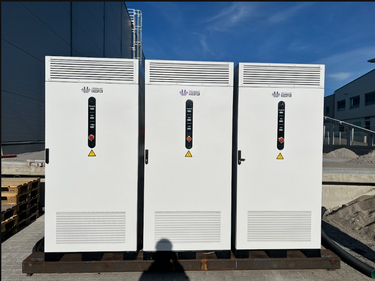
Battery Storage Efficiency: How Round-Trip Efficiency Impacts C&I BESS ROI
Two commercial and industrial (C&I) battery energy storage systems (BESS) can share identical nameplate energy capacities on paper yet deliver markedly different financial returns over their operating lives. Nameplate capacity does not equal usable energy, and usable energy does not directly equal project ROI. The divergence often comes down to how efficiently a system converts input electricity into delivered output. For commercial energy managers, EPCs, and project developers across Europe, evaluating BESS investments requires looking beyond nominal storage numbers.
The critical question is not simply how many kilowatt-hours (kWh) a battery can hold, but how much usable energy it returns and what that energy costs over time. Understanding battery storage efficiency bridges technical performance with financial returns.
What Is Round-Trip Efficiency in Battery Storage?
Battery round-trip efficiency measures the percentage of electricity charged into a storage system that can be successfully retrieved during discharge. Expressed mathematically:
Round-Trip Efficiency (RTE) = (Energy Discharged (kWh) / Energy Charged (kWh)) × 100%
If a system charges 1,000 kWh of electricity and discharges 900 kWh into the facility load, its round-trip efficiency is 90%. The remaining 100 kWh represents energy lost during chemical conversion, power conversion, and auxiliary system operation.
When evaluating BESS options, the measurement boundary is critical:
- DC-side (battery-block) efficiency: Measures energy losses occurring strictly within the battery cells and DC bus.
- AC-side (system-level) efficiency: Measures net energy performance across the complete system boundary, from the AC grid input to the AC energy delivered to the site load.
For C&I project economics, system-level AC round-trip efficiency is generally more representative than a DC-block figure because it incorporates all conversion and auxiliary losses. System losses accumulate across battery cell internal resistance, Power Conversion Systems (PCS), step-up transformers, site cabling, battery management systems (BMS), and continuous auxiliary cooling. The National Renewable Energy Laboratory (NREL) notes that RTE can be evaluated on a DC-DC or AC-AC basis, emphasizing that AC-AC efficiency better reflects true net energy throughput. Consequently, a headline DC efficiency figure of 95% will be higher than the net AC-to-AC efficiency of the complete operating system.
How Does Round-Trip Efficiency Affect Usable Energy?
A higher BESS round-trip efficiency rating does not increase a battery's nominal storage capacity. Instead, it minimizes parasitic energy losses during each cycle, ensuring that a larger fraction of input electricity becomes usable output.
| Round-Trip Efficiency | Energy Charged | Energy Delivered | Energy Lost per Cycle |
| 90% RTE | 1,000 kWh | 900 kWh | 100 kWh |
| 95% RTE | 1,000 kWh | 950 kWh | 50 kWh |
Assuming identical charging energy and test conditions, increasing system RTE from 90% to 95% recovers an additional 50 kWh per 1,000 kWh cycle. Over hundreds of annual cycles, this yield difference represents thousands of recovered kilowatt-hours.
How Does RTE Impact C&I BESS ROI?
To evaluate how C&I BESS efficiency directly influences project cash flows, consider a representative 1 MWh commercial battery storage system executing 300 equivalent full cycles per year with 1,000 kWh charged per cycle:
90% System RTE:
1,000kWh x 90% x 300 cycles = 270,000 kWh delivered per year
95% System RTE:
1,000kWh x 95% x 300 cycles = 285,000 kWh delivered per year
Annual Delivered Energy Delta:
15,000 kWh/year
The financial value of this 15,000 kWh energy difference depends on the application, including self-consumption, tariff optimization, peak shaving, EV charging, or flexibility services.
The European Commission highlights energy storage as an important flexibility solution that helps consumers adapt energy consumption to electricity prices and grid needs. Because European electricity costs encompass energy generation prices, network charges, taxes, and local levies, the financial return on recovered energy varies significantly across European markets such as Germany, Italy, Spain, the Netherlands, Belgium, France, and the UK. Consequently, the value of additional delivered energy must be evaluated using site-specific tariff structures and operational profiles.
RTE and Levelized Cost of Storage (LCOS)
Levelized Cost of Storage (LCOS) estimates the total cost of delivering stored energy over a system's lifetime (€/kWh). Because RTE determines the input energy required to deliver each output kWh, it directly alters operating expenditure. A 2026 study in the Journal of Energy Storage identified round-trip efficiency and annual full-load hours as dominant sensitivities in LCOS modeling.
However, higher RTE does not automatically deliver higher ROI or lower LCOS. If achieving an efficiency gain requires disproportionately high initial capital expenditure (CAPEX), the upfront hardware cost can outweigh the financial value of the recovered energy over the project lifecycle.
How Should European C&I Buyers Compare BESS Efficiency?
When reviewing technical datasheets during procurement, European energy buyers, developers, and technical teams should evaluate efficiency figures through four core questions:
1.Is the RTE measured on the DC or AC side?
DC-block figures exclude conversion and auxiliary losses. For project-level financial modelling, buyers should request a clearly defined AC-to-AC efficiency figure where appropriate, together with the measurement boundary and test conditions.
2.Are auxiliary loads included in the stated metric?
Verify whether power consumed by liquid cooling chillers, thermal pumps, environmental controls, and BMS electronics is integrated into the net efficiency calculation over a full operational duty cycle.
3.Under what operating conditions is RTE measured?
Request specific test parameters regarding State of Charge (SOC) operating window, charge/discharge C-rate, ambient operating temperature, and power factor.
4.Is the efficiency figure a typical design value or a contractual guarantee?
Distinguish between ideal laboratory design metrics and contractual performance guarantees backed by service level agreements (SLAs) or performance warranty terms.
What Other BESS Factors Affect Project Economics?
Evaluating energy storage system efficiency in isolation can distort economic projections. Round-trip efficiency is only one technical variable within a multi-factor financial model.
| Factor | Primary Impact on Project Economics |
| Round-Trip Efficiency (RTE) | Governs the proportion of input charging energy recovered as usable output. |
| Usable Capacity & DoD | Determine how much of the nominal capacity can be used per cycle and can influence lifetime degradation depending on operating conditions. |
| Capital Expenditure (CAPEX) | Establishes initial hardware, installation, balance of plant (BOP), and grid connection costs. |
| Cycle Life & Degradation Rate | Dictates lifetime energy throughput before capacity augmentation or asset replacement is required. |
| Auxiliary Consumption | Accounts for baseline HVAC, active liquid cooling, and control system parasitic power draws. |
| PCS Efficiency | Controls conversion efficiency across partial load profiles and varying operational states. |
| Energy Management System (EMS) | Optimizes dispatch timing based on site load patterns, solar availability, and tariff structures. |
How Ultimati Energie Approaches C&I BESS Performance
For C&I projects, Ultimati Energie approaches BESS performance at the complete system level rather than evaluating battery efficiency in isolation. System architecture, PCS integration, thermal management, EMS logic, usable capacity, and operating strategy all dictate the usable energy a project ultimately delivers. For European projects, these technical parameters are evaluated alongside local tariff structures, grid conditions, and duty cycles to determine realistic industrial battery storage costs and return metrics.
Frequently Asked Questions
What is round-trip efficiency in battery storage?
Round-trip efficiency (RTE) is the ratio of net energy discharged from a storage system to the total energy consumed to charge it, expressed as a percentage: .
What is a good round-trip efficiency for a C&I BESS?
There is no single RTE benchmark that applies to every C&I BESS because efficiency depends on the system architecture, measurement boundary, operating conditions, and whether auxiliary loads are included. Buyers should compare AC-to-AC RTE figures measured under comparable conditions rather than comparing headline DC-block efficiency values alone.
How does round-trip efficiency affect BESS ROI?
RTE affects BESS ROI by determining the volume of charging energy recovered as usable output. Higher RTE increases lifetime energy throughput per charged kWh, though final project ROI depends equally on CAPEX, utilization, degradation, and local electricity tariffs.
Conclusion
Round-trip efficiency is fundamentally an economic parameter: it governs how much input energy is converted into usable, revenue-generating electricity over a system's operating life. However, RTE should never be evaluated in isolation. Selecting the optimal C&I BESS for a European project requires evaluating system-level AC efficiency alongside initial CAPEX, usable capacity, degradation behavior, cycle life, and site-specific electricity tariffs. By analyzing full system performance boundaries rather than headline DC figures, commercial buyers and developers can build more accurate financial models and secure durable project ROI.

Ultimati Energie Deutschland GmbH is a Germany-based B2B energy storage system provider specializing in scalable residential and C&I battery storage solutions for European partners.
Become a Partner
Sales: +49 1624886367
Customer Support:
+49 15226994869
Address: Ober der Röth 4, 65824 Schwalbach am Taunus, Germany
Copyright © 2026 Ultimati Energie Deutschland GmbH All rights reserved.