

Industrial battery energy storage systems (BESS) are becoming an important energy management solution for European businesses facing rising electricity costs, increasing grid constraints, and the growing demand for renewable energy integration.
While the investment cost of an industrial battery storage system typically ranges from €450–900 per kWh at system level, the actual economic value depends on how the system is used.
For commercial and industrial users, battery storage can reduce peak demand charges, optimize renewable energy consumption, support EV charging infrastructure, and provide backup power for critical operations.
In this guide, we explain how these costs are composed, which factors determine ROI, and how you can realistically calculate your own project—using three practical scenarios and a transparent calculation logic for commercial and industrial applications in Europe.
What Does an Industrial Battery Energy Storage System Really Cost?
At system level, typical capital investment (CAPEX) for industrial battery storage in Europe falls roughly within:
Approx. €450–900 per kWh of storage capacity (system-wide)
This value includes not only the battery itself, but the entire Battery Energy Storage System (BESS). A complete industrial BESS normally consists of:
- Battery modules and Battery Management System (BMS)
- Power Conversion System (PCS)
- Energy Management System (EMS)
- Container or cabinet integration
- Cooling and fire protection systems
- Installation and commissioning
- Grid connection equipment
Actual costs vary depending on:
- System size (MWh)
- Grid connection conditions
- Component quality and warranties
- Integration effort (EMS, controls, monitoring)
Typical System-Level Price Ranges (€/kWh)
Larger systems usually benefit from economies of scale—especially in engineering, grid connection, and system integration.
Cost Structure in Detail: Where Does the Money Go?
To make informed decisions, it is helpful to break down the cost of an industrial battery storage system into individual building blocks.
CAPEX vs. OPEX – What You Should Plan For
CAPEX (Capital Expenditure): One-time costs for hardware, installation, and commissioning.
OPEX (Operating Expenditure): Ongoing costs for maintenance, software licenses, service, and possibly insurance.
A frequently underestimated aspect is long-term system reliability: high-quality components and a powerful EMS significantly reduce total operating costs over the system’s lifetime.
The Biggest Cost Drivers (Decision Factors)
1) System Size (MWh)
The larger the BESS system, the lower the cost per kWh typically becomes. At the same time, requirements for grid connection, control, and integration increase.
2) Application
- Peak shaving: Highly economical where demand charges are high
- Backup power: Valuable for critical processes (e.g., data centers, pharma, manufacturing)
- EV charging hubs: Storage reduces demand charges and stabilizes grid connection
- Self-consumption optimization (PV + storage): Reduces grid imports and increases self-sufficiency
3) Grid Connection & Permits
Grid connection rules differ significantly across countries such as Germany, Italy, and Spain. Hidden costs often arise from required transformers, grid reinforcements, or additional protection equipment.
4) Battery Quality & Warranty
Higher cycle life, better safety standards, and longer warranties increase upfront cost but reduce total cost of ownership (TCO) over time.
5) System Integration (EMS + Controls)
A high-performance EMS maximizes savings and minimizes risks—making it a central lever for ROI.
ROI – When Does an Industrial Battery Storage System Pay Off?
Simplified formula:
ROI ≈ (Annual savings − Operating costs) / Investment costs
Key input parameters:
- Annual electricity consumption
- Demand charge (€/kW)
- Tariff structure (peak / off-peak)
- Storage size (MWh)
- Cycles per year
- Maintenance costs
Three Realistic Application Scenarios with Example Calculations
Scenario A – Peak Shaving in a Factory
- Annual consumption: 5 GWh
- Demand charge: €120/kW/year
- Installed storage: 2 MWh / 1 MW
- Annual savings: approx. €120,000
- Payback period: 6–8 years
Very attractive for energy-intensive businesses with high demand charges.
Scenario B – Battery-Buffered EV Charging Hub
- 10 fast chargers at 150 kW each
- Without storage: very high demand charges
- With 1.5 MWh storage: peak load reduction
- Annual savings: €80,000–150,000
Storage is almost essential for profitable charging parks.
Scenario C – Backup Power for Critical Processes
- Production downtime cost: €50,000 per hour
- Average outage time: 2 hours per year
- Storage as backup solution: investment justified
Less about ROI—more about risk mitigation and operational security.
Comparison: Battery vs. Diesel Generator
In most cases, battery storage is the more economical and sustainable solution—especially over the long term.
Country Differences in Europe
🇩🇪 Germany
- High grid charges → strong motivation for peak shaving
- KfW and regional subsidy programs available
🇮🇹 Italy
- Attractive commercial electricity tariffs
- High profitability of PV + storage
🇪🇸 Spain
- High share of renewable energy
- Strong synergies between PV and battery storage
How to Calculate Your Project Step by Step
- Define the application
- Determine required storage capacity
- Collect electricity and demand price data
- Choose system architecture (AC vs. DC)
- Calculate annual savings
- Estimate payback period and ROI
- Select an experienced system provider
Next Step – Work with a Reliable Partner
When planning an industrial battery storage project, choosing the right system provider is decisive for cost, performance, and long-term profitability.
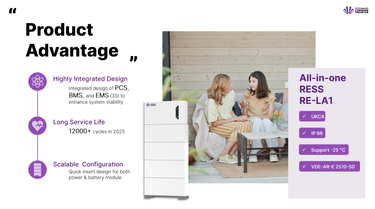
Ultimati Energie supports you from initial feasibility analysis through system design, commissioning, and long-term service. Our C&I energy storage solutions are optimized for European grids, modularly scalable, and designed for long service life.
Common Mistakes in Cost and ROI Evaluation
- Underestimating grid connection costs
- Ignoring OPEX
- Not accounting for electricity price volatility
- Choosing the wrong system architecture
- Using an insufficient EMS
- Focusing only on €/kWh instead of system performance
Conclusion – Industrial Battery Storage as a Strategic Asset with the Right Partner
An industrial battery energy storage system in Europe typically costs €450–900 per kWh at system level—but this number alone does not determine project success. What matters is ROI, which can be achieved within 5–8 years in many applications, especially peak shaving, EV charging infrastructure, and critical backup.
When properly planned, an industrial battery storage system becomes a strategic asset rather than a cost factor: it lowers energy costs, stabilizes power supply, and improves sustainability performance.
With Ultimati Energie as your partner, you receive not just a product, but a fully integrated C&I energy storage solution—technically reliable, grid-compliant, and economically optimized.