

Battery Storage for EV Charging Parks: When Is It Worth It?
Commercial EV charging parks are becoming increasingly important for businesses, logistics sites, commercial properties, hotels, supermarkets, and fleet operators. As more electric vehicles enter daily operation, many sites face growing pressure on their grid connection—especially when multiple vehicles charge at the same time or DC fast chargers are installed.
A battery energy storage system, or BESS, can help address this challenge. It buffers short-term power peaks, supports the use of on-site solar energy, and helps businesses make better use of their available grid capacity.
This article explains when battery storage for commercial EV charging parks is worth the investment, which economic factors matter, and how companies can align battery size, charging power, and grid connection for reliable and efficient operation.
Why Commercial EV Charging Parks Put Pressure on the Grid
A single EV charging point is usually manageable for many commercial sites. The challenge begins when multiple vehicles charge at the same time or when DC fast chargers are added. In these cases, short-term power demand can rise significantly.
For commercial EV charging sites, planning depends heavily on the available grid capacity and how often high charging loads actually occur. If the existing connection is not sufficient, companies need to assess whether a grid upgrade is required or whether battery storage, load management, and a PV system can work together as a more cost-effective solution.
How Battery Storage Works in an EV Charging Park
In a commercial EV charging park, a battery storage system works as a power buffer between the grid, PV system, charging infrastructure, and on-site energy consumers.
The battery charges when electricity demand is low or when surplus solar power is available. When several vehicles charge at the same time and site demand rises, the battery supplies additional power. This reduces short-term demand on the grid connection.
An intelligent energy management system controls when the battery is charged or discharged. In an EV charging park, BESS can reduce peak loads, support solar self-consumption, and provide short-term charging power. For businesses, it is not only a commercial battery storage system, but also an active part of the charging and energy strategy.
When Is Battery Storage Worth It for EV Charging Parks?
Whether a battery storage system makes sense for a commercial EV charging park depends on the site conditions, charging power, usage profile, grid limits, and existing energy infrastructure. It is especially valuable when battery storage can solve more than one challenge at the same time, such as limited grid capacity, peak loads, solar integration, or fast charging support.
Limited Grid Capacity or DC Fast Charging
Battery storage is often valuable when the existing grid connection is not sufficient for the planned EV charging infrastructure, or when the available capacity is only slightly above expected demand. This is especially relevant for sites adding more charging points, DC chargers, or fast charging stations.
In these situations, a battery can buffer short-term power peaks and make better use of available grid capacity. This is particularly useful when an EV charging park needs to expand, high charging power is only required at certain times, or maximum grid demand must remain limited.
A battery storage system does not always replace a grid upgrade. However, it can make the overall project design more flexible and economically practical, especially for grid-constrained EV charging sites.
Peak Shaving and Demand Charge Reduction
Many commercial electricity tariffs include demand charges in addition to energy consumption costs. When several vehicles charge at the same time, site power demand can rise quickly. If this peak demand is relevant for billing, it can have a significant impact on electricity costs.
Battery storage can support peak shaving by reducing these short-term spikes. When grid demand reaches a defined threshold, the battery discharges and supplies part of the required power. This helps keep grid demand below the target level and can support demand charge reduction.
This is especially relevant for commercial EV charging sites with multiple charging points, regular simultaneous charging sessions, high demand charges, or additional power needs from production, cooling systems, heat pumps, or building equipment.
Predictable Fleet or Customer Charging Patterns
Battery storage works best when the EV charging park is used regularly. The more predictable the charging times and load profiles are, the more effectively the battery can be charged and discharged.
Typical examples include company fleets, logistics vehicles, employee parking areas, retail locations, and commercial properties with recurring charging patterns. These sites often have predictable load profiles that can be managed more effectively with battery storage and intelligent load management.
If an EV charging park is rarely used or charging demand is highly irregular, battery storage may be less cost-effective. The key factor is not only installed charging capacity, but actual usage during daily operation.
PV Integration and Solar Self-Consumption
Battery storage becomes especially useful when the EV charging park is combined with a PV system or solar carport. Many commercial sites have roof areas or parking areas that can generate solar power for EV charging infrastructure.
Solar generation and charging demand do not always occur at the same time. A battery can store solar power and make it available later for vehicle charging. This increases solar self-consumption while reducing grid electricity use.
For commercial sites with on-site solar generation, battery storage is often more attractive than for charging parks without renewable energy generation.
When Battery Storage May Not Be Worth the Investment
Battery storage is not automatically the right choice for every commercial EV charging park. The investment may be harder to justify if the site only has a few low-power AC chargers, limited charging activity, or no significant peak loads.
It may also be less relevant when the existing grid connection is already sufficient, no PV system is available, the electricity tariff has little or no demand-based pricing, or charging times are highly irregular. In these cases, intelligent load management, adjusted charging park planning, or a later battery storage retrofit may be more appropriate.
Before investing, companies should assess whether the load profile, charging power, grid capacity, electricity tariff, and potential PV generation can create a clear economic benefit for battery storage.
Grid Upgrade or Battery Storage: Which Option Makes More Sense?
In many EV charging projects, the key question is whether the grid connection must be upgraded or whether battery storage can help make better use of the available grid capacity.
The right answer depends on the site conditions. In some cases, a grid upgrade is unavoidable. In others, battery storage can buffer short-term peak loads, limit maximum grid demand, and help avoid or delay a larger grid connection upgrade.
| Factor | Grid Connection Upgrade | Battery Storage System |
|---|---|---|
| Implementation | Depends on utility and site conditions | Often more flexible to plan |
| Investment | Highly site-dependent | Scalable based on project needs |
| Peak load reduction | No | Yes |
| Short-term charging power buffer | No | Yes |
| PV self-consumption | No direct impact | Can increase on-site solar use |
| Expandability | Depends on available grid capacity | Modular planning possible |
| Operating cost impact | Limited | Possible through peak shaving and self-consumption |
In many projects, the best solution is not simply a grid upgrade or battery storage. It is the right combination of grid capacity, battery storage, PV system, and intelligent load management.
How to Size a Battery Storage System for an EV Charging Park
The right battery size does not depend only on the number of charging points. A more important question is how much power is needed at the same time during real operation, and what grid demand limit the site needs to maintain.
For example, an EV charging park with ten charging points can have very different storage requirements depending on AC or DC charging power, charging simultaneity, and usage profile. This means the battery should not be sized using a simple rule of thumb, but based on the actual or expected load profile.
In practice, sizing should start with the site’s target grid limit: how much power can be drawn from the grid, and how much additional power must the battery provide during charging peaks?
Other important factors include the duration and frequency of peak demand, the daily charging profile, potential PV generation, and future expansion plans. An undersized battery may only reduce peaks to a limited extent, while an oversized battery increases investment costs and may not be used efficiently.
That is why companies should first define the main purpose of the battery storage system: peak shaving, solar self-consumption, fast charging support, or a combination of these functions.
What Drives the ROI of Battery Storage in EV Charging Parks?
The return on investment of battery storage for commercial EV charging parks depends strongly on real charging behavior. There is no universal payback period because every site has different load profiles, electricity tariffs, grid conditions, and investment costs.
One important factor is the available grid capacity. If a battery helps avoid, reduce, or delay a larger grid upgrade, it can improve the economics of the charging park. At the same time, it can provide short-term additional charging power without permanently increasing grid demand.
Peak shaving is also central. For businesses with demand-based electricity costs, battery storage can reduce peak loads and limit maximum grid demand. The more regularly these peaks occur during charging operation, the more relevant this effect becomes.
For sites with PV systems, battery storage can further improve ROI by increasing solar self-consumption and reducing grid electricity use during charging periods. Low-cost or time-variable electricity tariffs may also support the business case, but this should always be assessed based on the specific site.
For public charging parks, retail locations, fleet charging sites, or fast charging infrastructure, battery storage can also support charging availability. If more vehicles can be charged or higher charging power can be offered, additional charging revenue may become possible. However, companies must also consider battery purchase costs, installation, inverters, energy management, maintenance, service life, and usable cycles.
A battery storage business case is usually strongest when one system can solve multiple problems at once: grid limitation, peak shaving, PV self-consumption, and charging availability.
Practical Example: Electric Truck Fast Charging with PV and Battery Storage in Alheim
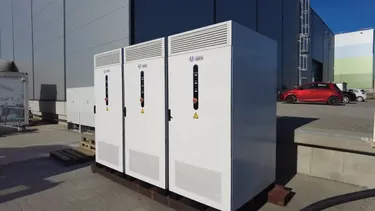
A relevant example is the Ultimati Energie project in Alheim, Germany. The site combines electric truck fast charging with 2 × 400 kW DC fast chargers, a 600 kWp PV system, and 3 × UltiBlock TL261 energy storage systems. With the grid connection limited to 160 kW, the battery storage system helps provide high charging power, integrate PV energy, and support dynamic load management for the charging infrastructure. This project shows how battery storage can support commercial EV charging parks when fast charging demand, limited grid capacity, and renewable energy generation need to work together.
Learn more in our Alheim electric truck fast charging project.
Conclusion: When Is Battery Storage Worth It for Commercial EV Charging Parks?
Battery storage is especially worthwhile for commercial EV charging parks when high charging power, limited grid capacity, significant peak loads, and regular charging demand come together. The business case becomes even stronger when a PV system or solar carport is already available or planned.
However, not every EV charging park automatically needs battery storage. The key is a site-specific analysis of the load profile, grid conditions, PV generation, load management strategy, and future energy demand. In most projects, the best result comes from planning the grid connection, charging points, PV system, energy management, and battery size as one integrated system.
Plan Commercial EV Charging Infrastructure with Battery Storage
Planning an EV charging park with battery storage? Ultimati Energie helps you plan scalable battery storage solutions for commercial EV charging infrastructure, PV systems, and C&I energy systems. Together, we align charging power, battery size, grid capacity, and energy use so your charging park can operate reliably and economically.

Ultimati Energie Deutschland GmbH is a Germany-based B2B energy storage system provider specializing in scalable residential and C&I battery storage solutions for European partners.
Become a Partner
Sales: +49 1624886367
Customer Support:
+49 15226994869
Address: Ober der Röth 4, 65824 Schwalbach am Taunus, Germany
Copyright © 2026 Ultimati Energie Deutschland GmbH All rights reserved.