

AC-Coupled Battery Retrofit for Existing PV Systems: Technical Requirements & Compatibility Guide
Many solar PV systems were originally installed without battery storage. During the day, the PV system generates solar power that can be used directly in the home or exported to the grid. In the evening or at night, however, when the solar panels are no longer producing electricity, the household still needs to draw power from the grid.
This is where an AC-coupled battery retrofit can add value. For homeowners who want to add battery storage to an existing solar PV system, AC coupling can increase self-consumption, reduce grid dependence, and make better use of surplus solar energy without necessarily replacing the existing solar inverter.
However, retrofitting a solar battery is not just about choosing a battery size. The right solution depends on technical compatibility, metering design, grid connection, electrical installation, battery capacity, battery power, load profile, backup requirements, and overall installation cost.
What Is an AC-Coupled Battery Storage System?
An AC-coupled battery storage system is connected on the alternating current side of the home electrical system. The existing PV system continues to generate solar power through the existing solar inverter, while the battery storage system is added separately to the home’s AC electrical system.
In simple terms, the solar panels generate electricity. The existing PV inverter converts this electricity into AC power for household use. When the PV system produces more electricity than the home is consuming, the AC-coupled battery can store the surplus energy. Later, when household demand is higher and solar generation is low, the battery discharges electricity back into the home.
The key advantage of an AC-coupled retrofit is flexibility. In many existing PV systems, the original solar inverter can continue to operate. This makes AC-coupled battery storage a practical option for retrofit projects where the goal is to add energy storage without rebuilding the entire solar system.
Compared with DC-coupled battery systems, AC-coupled solutions are often easier to integrate into existing PV installations. DC-coupled energy storage systems can be efficient for new solar installations or projects where the inverter is being replaced, but they usually require more changes to the existing PV system. For many battery storage retrofit projects, AC coupling is the more practical approach.
Battery Storage Retrofit for Existing Solar PV Systems: Technical Requirements and Compatibility Checks
Before adding a solar battery to an existing PV system, the current installation should be assessed carefully. The key question is not only whether a battery can be connected, but whether the complete PV, battery, metering, and electrical system can operate safely, reliably, and efficiently after the retrofit.
Before planning an AC-coupled battery retrofit, check:
Is the existing solar inverter still reliable and grid-compliant?
Does the PV system regularly produce surplus solar power?
Is the electrical panel suitable for additional components?
Is accurate metering possible at the grid connection point?
Is backup power required, or only self-consumption optimization?
Do battery capacity and output power match the load profile?
Are EV chargers, heat pumps, or future high-power loads planned?
Existing Solar Inverter
With an AC-coupled battery retrofit, the existing solar inverter can often remain in use. This is one of the main reasons AC-coupled systems are attractive for existing PV systems. However, the inverter should still be checked before the battery storage system is installed.
The key question is whether the existing solar inverter continues to operate safely and in compliance with grid requirements, and whether the AC-coupled battery system can be controlled independently. The battery system must be able to detect solar surplus, charge correctly, discharge at the right time, and integrate safely into the existing home electrical system.
Important questions include:
How old is the existing solar inverter?
What is the capacity of the existing PV system?
Is the inverter operating reliably and in compliance with grid requirements?
Does the system already include monitoring or communication equipment?
Is an inverter replacement planned in the near future?
Should the existing inverter continue to be used long term?
Although AC-coupled battery systems are less dependent on the existing PV inverter than DC-coupled systems, the condition of the current system still matters. An old, unreliable, or undersized inverter can affect system planning and should be considered during the compatibility assessment.
Metering Design and Energy Measurement
A battery storage system can only charge and discharge effectively if solar generation, household consumption, and grid export are measured correctly. For this reason, the metering design is one of the most important technical requirements in a solar battery retrofit.
In most cases, an energy meter or smart meter is needed at the correct measurement point. This device measures whether the home is importing electricity from the grid or exporting surplus solar power. Based on this data, the energy management system decides when the battery should charge or discharge.
Key points include:
accurate measurement of grid import and export
correct placement of the energy meter or CT sensors
reliable detection of surplus solar power
coordination with energy management, EV chargers, or heat pumps
consideration of export limits or zero-export requirements where applicable
A poorly designed metering setup can cause the battery to charge too late, discharge unnecessarily, or fail to detect available solar surplus. This can reduce system performance and limit the benefits of the retrofit.
Grid Connection, Standards, and Registration
A retrofitted battery storage system becomes part of the home’s electrical installation. It must therefore be planned, installed, and commissioned properly. Local grid connection rules, utility requirements, and applicable electrical standards must be taken into account.
Depending on the project location and system design, the battery storage system may need to be reported to the local grid operator or registered with relevant authorities. Requirements related to electrical safety, grid protection, anti-islanding protection, and system commissioning may also apply.
For system owners, this means a solar battery retrofit should not be treated as a simple plug-and-play upgrade. The battery must be installed by qualified professionals so that the complete system can operate safely, reliably, and in compliance with local regulations.
Electrical Installation and Distribution Board
In addition to the PV system and inverter, the home’s electrical distribution must also be reviewed. In older buildings, the distribution board or electrical panel can become an important planning and cost factor.
The following points should be checked:
condition of the electrical panel or distribution board
available connection capacity
protection devices and electrical safety design
single-phase or three-phase integration
space for additional components
requirements from EV chargers, heat pumps, or other high-power loads
When several electrical loads are involved, it is not enough to consider battery capacity alone. The output power of the battery system and its electrical integration must also match the household’s real energy demand.
Battery Capacity and Battery Power
When selecting a retrofit solar battery, two values are especially important: battery capacity and battery power.
Battery capacity is measured in kWh. It describes how much energy the battery can store. Battery power is measured in kW. It describes how much power the battery can charge or discharge at one time.
Both values matter when adding battery storage to an existing solar system. A battery with large capacity may not perform well if the charge or discharge power is too low for the household’s load profile. At the same time, a high-power battery may not be economical if the PV system does not generate enough surplus energy to charge it regularly.
When sizing a battery storage system, the following factors should be considered:
annual electricity consumption
solar PV generation
evening and nighttime electricity demand
usable battery capacity
planned loads such as EV chargers or heat pumps
future expansion requirements
A larger battery is not always the better choice. In many cases, a properly sized battery is more cost-effective than an oversized system that is not fully used in daily operation.
Backup Power, Emergency Power, and Whole-Home Backup
Many users assume that a retrofitted battery storage system will automatically provide power during a grid outage. This is not always the case.
A standard battery system designed for self-consumption does not automatically function as a backup power system. Backup capability usually requires additional technical components, such as a backup-ready battery inverter, an automatic transfer switch, a backup box, or a dedicated backup circuit.
Before installation, the following questions should be clarified:
Is the battery intended only for self-consumption?
Should selected loads remain powered during an outage?
Is single-phase or three-phase backup required?
Which critical loads should be protected?
Should the PV system continue charging the battery during a grid outage?
If backup power or emergency power is required, it should be included in the system design from the beginning. Adding backup functionality later can be more complex and may require additional electrical work.
Installation Location and Safety
The installation location also plays an important role in a battery storage retrofit. The battery should be installed in a safe, suitable, and accessible location.
Important considerations include:
permitted operating temperature range
ventilation requirements
system protection rating
distance from heat sources
clear access to escape routes
secure wall-mounted or floor-mounted installation
access for maintenance and service
Manufacturer requirements and local installation standards should always be followed. A suitable installation location supports safety, long-term performance, and battery life.
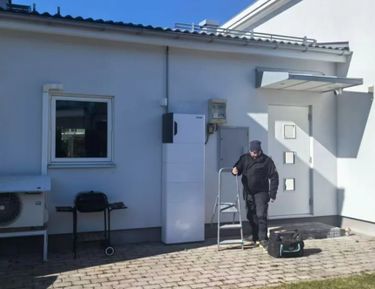
How such a retrofit can look in practice is shown in our project example of a home battery retrofit in Malmö, where an existing PV system was expanded with a 7.6 kWh residential battery storage system.
Solar Battery Retrofit Costs: What Affects the Total Price?
The cost of retrofitting a battery storage system depends on more than battery capacity alone. System type, installation complexity, electrical panel upgrades, energy management, monitoring, and backup functions can all influence the total project cost.
Important cost factors include:
battery capacity and battery power
AC-coupled battery system or separate battery inverter
installation work and possible electrical panel upgrades
energy meter, monitoring, and energy management system
backup power or emergency power function
regional installation costs
available incentives or subsidies
current electricity price and solar export tariff
The overall economics should always be considered carefully. The battery price alone says little about the total cost of a retrofit project. What matters is the complete system, including installation, metering design, electrical upgrades, monitoring, and energy management.
A low-cost battery is not necessarily the best choice if it does not fit the existing PV system technically. At the same time, a very large battery is not automatically more economical if it is not used effectively in daily operation.
For this reason, solar battery retrofit costs should always be assessed in relation to the existing PV system, household consumption profile, and long-term energy goals.
When Does Retrofitting a Solar Battery Make Sense?
Whether a battery storage retrofit makes sense depends on the relationship between solar generation, self-consumption, electricity prices, export tariffs, and investment cost. The key question is not only how much electricity the PV system produces, but when that electricity is needed in the home.
A retrofit solar battery can be a good option when:
the existing PV system regularly produces surplus solar power
a large share of electricity consumption occurs in the morning, evening, or at night
export compensation is low and grid electricity prices are relatively high
additional loads such as EV chargers or heat pumps are planned
the PV system will continue operating for many years
the retrofit can be completed without major electrical reconstruction
A battery retrofit may be less suitable if the PV system is very small, produces little surplus energy, or the home already uses most of its solar power during the day. A very attractive feed-in tariff may also reduce the economic benefit of adding battery storage.
The most important rule is simple: the battery should not be selected based only on maximum capacity. It should be sized according to actual household demand. Only when PV generation, load profile, battery size, system cost, and compatibility work together can the retrofit provide long-term value.
FAQ: AC-Coupled Battery Retrofit for Existing PV Systems
Can you add battery storage to any existing solar PV system?
In many cases, yes. However, not every PV system is automatically suitable for a battery retrofit. The existing inverter, electrical panel, grid connection, metering design, PV generation, and household consumption profile should all be assessed before installation.
Is an AC-coupled battery better for existing PV systems?
For many existing PV systems, an AC-coupled battery is a practical solution because it can be integrated into the home electrical system while the existing solar inverter remains in use. However, the best solution depends on the existing system design and project requirements.
Do I need to replace my existing solar inverter?
With an AC-coupled battery retrofit, the existing solar inverter often does not need to be replaced. However, replacement may be considered if the inverter is old, unreliable, technically limited, or if the system is already being modernized.
How much does it cost to retrofit a solar battery?
The cost depends on battery capacity, battery power, system type, installation work, electrical panel condition, energy management, monitoring, and additional functions such as backup power. For this reason, retrofit cost should always be evaluated on a project-specific basis.
Does a retrofitted battery automatically provide backup power?
No. A retrofitted battery storage system does not automatically provide backup power. Backup operation requires a compatible battery inverter, transfer equipment, and proper electrical design.
What size battery do I need for an existing PV system?
The right battery size depends on PV generation, electricity consumption, evening and nighttime demand, and any planned additional loads such as EV chargers or heat pumps. The goal is not to choose the largest battery, but to match usable capacity and output power to the actual load profile.
Conclusion
An AC-coupled battery retrofit can be a flexible way to add battery storage to an existing solar PV system. In many cases, the existing solar inverter can continue to operate while the battery is added separately to the home electrical system. This makes AC-coupled battery storage especially suitable for retrofit projects where homeowners want to improve self-consumption without rebuilding the entire solar installation.
However, the decision should not be based on battery price alone. Technical compatibility, metering design, grid connection, battery capacity, battery power, electrical installation, load profile, and backup requirements all need to be considered. A well-planned retrofit helps ensure that the battery storage system works safely, efficiently, and economically with the existing PV system.
Planning to add battery storage to an existing solar PV system? Ultimati Energie helps homeowners, installers, and project partners choose suitable AC-coupled battery storage solutions for retrofit projects. Contact us to discuss compatibility, system configuration, and project requirements.

Ultimati Energie Deutschland GmbH is a Germany-based B2B energy storage system provider specializing in scalable residential and C&I battery storage solutions for European partners.
Become a Partner
Sales: +49 1624886367
Customer Support:
+49 15226994869
Address: Ober der Röth 4, 65824 Schwalbach am Taunus, Germany
Copyright © 2026 Ultimati Energie Deutschland GmbH All rights reserved.