

AC-Coupled vs. DC-Coupled Battery Storage: Which Is Right for Your Solar Project?
Choosing between an AC-coupled and a DC-coupled battery storage system depends mainly on your project situation. If you already have a solar PV system installed, an AC-coupled battery storage solution is often the more practical option because it can usually be retrofitted with fewer changes to the existing system. If you are planning a new solar PV system with battery storage, a DC-coupled system may offer advantages because solar energy can be stored more directly with fewer conversion steps.
However, there is no single best solution for every home. Battery capacity, inverter power, installation space, system expandability, backup power requirements, EV charger integration, heat pump usage, and energy management should all be considered. The right choice is not only about AC vs. DC coupling, but about how well the entire home energy storage system fits the building and its long-term energy needs.
This guide explains the difference between AC-coupled and DC-coupled battery storage, when each system architecture makes sense, and what homeowners, installers, and energy solution partners should consider before choosing a solar battery storage solution.
Quick Answer: Existing Solar System or New Solar Battery Project?
The most important question is simple: do you already have a PV system, or are you planning a new solar and battery storage project from the beginning?
| Project Situation | Commonly Suitable Solution |
|---|---|
| Existing PV system needs battery storage | AC-coupled battery storage |
| New solar PV system with battery storage is planned | DC-coupled battery storage |
| Existing PV inverter should continue to be used | AC-coupled solution |
| Higher system efficiency is a priority in a new project | DC-coupled solution |
| EV charger or heat pump will be added | Full system design should be reviewed |
| Backup or emergency power is required | Inverter, transfer switch, and battery system should be checked separately |
| Future storage expansion is planned | Modularity and system compatibility should be reviewed |
What Do AC-Coupled and DC-Coupled Battery Storage Mean?
To understand the difference between AC-coupled and DC-coupled battery storage, it is important to look at how electricity flows in a solar PV system. Solar panels generate direct current, or DC electricity. Most household appliances, the public grid, and standard home electrical systems use alternating current, or AC electricity. That is why a solar inverter is needed to convert DC power from the panels into usable AC power for the home.
The difference between AC and DC coupling is where the battery storage system is connected within the solar energy system. The battery itself is not necessarily the main difference. The key question is whether the battery is connected on the AC side or the DC side of the system.
AC-Coupled Battery Storage: Connected on the AC Side
In an AC-coupled battery storage system, the battery is connected on the AC side of the home electrical system. The DC electricity generated by the solar panels is first converted into AC electricity by the PV inverter. This electricity can then be used directly in the home, exported to the grid, or converted again by a battery inverter for storage in the battery.
The simplified energy flow looks like this:
Solar panels generate DC electricity → the PV inverter converts it into AC electricity → the home uses the power, or the battery inverter stores it in the battery system.
DC-Coupled Battery Storage: Connected on the DC Side
In a DC-coupled battery storage system, the battery is connected on the DC side of the system. The DC electricity generated by the solar panels can be stored more directly in the battery before being converted into AC electricity for household use.
The simplified energy flow is shorter:
Solar panels generate DC electricity → solar energy is stored on the DC side in the battery → the inverter converts it into AC electricity when needed.
This type of system is often designed around a hybrid inverter, which coordinates the PV system, battery storage, and household power supply. Because fewer conversion steps are required, a DC-coupled battery storage system can offer efficiency advantages in suitable projects.
In short, AC coupling connects the battery storage system on the alternating current side, while DC coupling connects it on the direct current side.
When Does an AC-Coupled Battery Storage System Make Sense?
An AC-coupled battery storage system is especially useful when an existing solar PV system needs to be expanded with a battery. Since the battery is connected on the AC side, the existing PV infrastructure can often continue to be used. This makes AC coupling particularly suitable for homeowners who want to increase solar self-consumption without making major changes to the existing solar system.
Typical Uses for AC-Coupled Battery Storage
An AC-coupled solar battery system is often a good fit for retrofit projects in existing solar homes. Typical situations include:
An existing PV system needs to be expanded with battery storage.
The existing PV inverter should continue to be used.
Excess solar power should be stored instead of being exported to the grid.
The homeowner wants to improve the return on an existing solar investment.
Battery integration should require minimal system modifications.
Intelligent energy planning is needed to reduce electricity drawn from the grid.
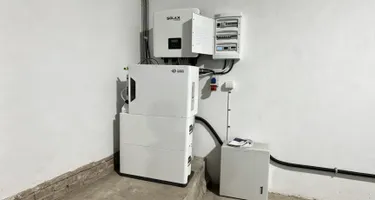
A practical example is the retrofit of an existing solar home in Malmö, Sweden. In this project, the existing PV system was not replaced. Instead, it was upgraded with the RESS-RE-HA1 high-voltage home battery storage system. Through an AC-coupled retrofit architecture, the battery was connected to the existing SolaX inverter, allowing excess solar power to be stored during the day and used later in the household.
More details are available in the full case study on AC-coupled battery storage retrofit in Malmö.
What Should Be Checked Before Choosing AC Coupling?
Although AC-coupled battery storage offers strong retrofit flexibility, the system should still be planned carefully. The key questions are whether the existing PV inverter can continue to be used, whether the selected battery storage system is compatible with the existing solar setup, and what battery capacity matches the household’s consumption profile.
Possible conversion losses, energy management requirements, and future system expansion should also be considered. An AC-coupled battery storage system is often the right choice when an existing PV system should remain in use, solar self-consumption should be increased, and battery integration should be completed with limited system changes.
When Does a DC-Coupled Battery Storage System Make Sense?
A DC-coupled battery storage system is especially suitable when a new solar PV system and battery storage system are planned together. Since the battery is connected on the DC side, this architecture works well for projects where the solar panels, battery, hybrid inverter, and energy management system can be designed as one integrated solution from the beginning.
Typical Uses for DC-Coupled Battery Storage
A DC-coupled solar battery storage system is often a good fit for projects where efficiency and integrated system planning are priorities. Typical situations include:
A new solar PV system with battery storage is being installed.
The battery storage system will be combined directly with a hybrid inverter.
Solar energy should be stored and used as efficiently as possible.
A compact and integrated system architecture is preferred.
PV capacity, battery capacity, and self-consumption should be planned together from the start.
The system should support future loads such as an EV charger or heat pump.
Benefits of DC-Coupled Battery Storage
The main advantage of DC-coupled battery storage is efficient use of solar energy. Because fewer conversion steps are required, conversion losses can be reduced. This can be especially valuable when a large share of solar power is stored during the day and used later in the evening or at night.
Another benefit is integrated system design. In many DC-coupled solar battery systems, a hybrid inverter manages both the PV system and the battery. This allows solar generation, battery charging, discharging, and household power supply to be coordinated through a more unified architecture.
What Should Be Checked Before Choosing DC Coupling?
Despite its efficiency advantages, a DC-coupled battery storage system is not automatically the best choice for every home. For existing PV systems, it is important to check whether the current inverter can still be used or whether it would need to be replaced by a hybrid inverter. In retrofit situations, this may increase installation complexity.
Compatibility between the battery storage system, hybrid inverter, and energy management system is also important. Expansion limits should be reviewed as well. A DC-coupled battery storage system is most suitable when a new solar battery project is being planned and all major system components can be matched from the beginning.
AC-Coupled vs. DC-Coupled Battery Storage
| Criteria | AC-Coupled Battery Storage | DC-Coupled Battery Storage |
|---|---|---|
| Connection point | AC side | DC side |
| Typical use case | Retrofitting existing PV systems | New solar battery storage projects |
| Inverter setup | Existing PV inverter can often continue to be used | Usually designed with a hybrid inverter |
| Efficiency | Flexible, but more conversion steps may occur | Often more efficient due to fewer conversions |
| System planning | Good for retrofit projects | Good for integrated new system design |
| Key point to check | Compatibility with the existing PV system | Compatibility between battery and hybrid inverter |
Why AC or DC Coupling Alone Is Not Enough
The choice between AC-coupled and DC-coupled battery storage is important, but it should not be made in isolation. An AC-coupled battery may be more practical for an existing PV system, while a DC-coupled battery may be more efficient for a new solar battery project. However, real-world performance also depends on battery capacity, inverter power, household consumption profile, installation location, system expandability, and energy management.
This is especially important for homes with an EV charger, heat pump, or backup power requirements. Coupling type only describes how the battery storage system is connected. A well-designed home energy storage system must consider the PV system, battery, inverter, EMS control, and future electrical loads together.
Conclusion
Whether AC-coupled or DC-coupled battery storage is the better choice depends mainly on whether you are expanding an existing PV system or planning a new solar battery storage project. AC-coupled battery storage is often the flexible option for retrofit projects, while DC-coupled systems can offer a more efficient architecture for new installations. For the right decision, the entire home energy system should always be reviewed.
If you are expanding an existing PV system or planning a new home energy storage project, Ultimati Energie can help you select a suitable, scalable battery storage solution for your residential project. Together, we can review which storage architecture fits your PV system, consumption profile, and future energy needs.

Ultimati Energie Deutschland GmbH is a Germany-based B2B energy storage system provider specializing in scalable residential and C&I battery storage solutions for European partners.
Become a Partner
Sales: +49 1624886367
Customer Support:
+49 15226994869
Address: Ober der Röth 4, 65824 Schwalbach am Taunus, Germany
Copyright © 2026 Ultimati Energie Deutschland GmbH All rights reserved.