

Utility-Scale vs. C&I Energy Storage: Applications, Boundaries, and How to Choose the Right System
Battery energy storage systems (BESS) show up at almost every point in the power grid today — next to wind and solar farms, inside substations, and behind the meter at factories and shopping centers. But not every storage system is built the same way, and not every system belongs in the same place.
The short answer to "what's the difference between utility-scale and C&I energy storage": it comes down to where the battery connects to the grid and how it's packaged. Utility-scale and large-scale storage systems are typically containerized, connect at medium voltage (10kV or 35kV), and sit above roughly 5MWh in capacity. Commercial and industrial (C&I) storage systems are integrated into a single low-voltage cabinet, connect at 400V, and usually range up to about 2MWh — sized to match what a factory, warehouse, or commercial building actually needs.
This guide breaks down where battery storage is used across the power system, where the practical boundary between C&I and utility-scale storage sits, and what to look for in a C&I system — using the liquid-cooled ULTIBLOCK-TL261 as a concrete example.
Where Battery Storage Fits Across the Power System
Energy storage is generally deployed in three layers of the grid: at the point of generation, on the grid itself, and at the end user's site. Each layer asks the battery to do a different job.
Generation-Side Storage (Paired with Wind and Solar)
When a battery sits next to a wind farm or solar plant, its main job is to make variable renewable output behave like a predictable resource. That includes responding to frequency deviations in milliseconds so the project can qualify for grid connection, shifting midday solar output into the evening peak to cut curtailment, smoothing minute-to-minute output swings, and — in island or microgrid setups — providing backup power or black-start capability when the main grid is unavailable.
Grid-Side Storage (Standalone Storage Plants)
Grid-side storage stands alone as its own power station, connected directly to the transmission or sub-transmission network and dispatched by the grid operator. These systems typically stack multiple revenue streams in a single day — frequency regulation in the morning, energy arbitrage at midday and peak hours, and capacity reserves overnight. They're also used to relieve congestion on overloaded transmission lines without the years-long lead time of building new infrastructure, and — when equipped with grid-forming inverters — to provide black-start capability after a major outage.
End-User-Side Storage: Where C&I and Utility-Scale Diverge
This is the layer where terminology gets confusing, because "storage" at a factory and "storage" at a shopping mall can mean two completely different pieces of equipment — even though both sit behind the meter.
Utility-Scale vs. C&I Storage: Key Differences at a Glance
Large-Scale / Utility-Scale Storage | C&I Storage | |
Grid connection | Medium voltage (10kV or 35kV) | Low voltage (400V) |
Typical capacity | ≥5MWh | ≤2MWh |
Equipment form factor | Containerized + step-up transformer | Single integrated cabinet |
Primary revenue model | Time-of-use arbitrage + demand management + ancillary services | Time-of-use arbitrage + demand charge management |
Typical owner | Large industrial users, energy service companies, third-party investment funds | Small-to-mid-size factories, commercial buildings, EV charging site owners |
In practice, the deciding factor is rarely "how much storage do I want" — it's how much electrical infrastructure the site already has. A facility with a 400V service connection and a roof full of solar panels is a textbook C&I candidate. A facility with its own medium-voltage substation and multi-megawatt demand starts to make sense for a large-scale, container-based system instead.
What Is C&I Energy Storage Used For?
For the vast majority of factories, warehouses, retail sites, and EV charging operators, a single low-voltage cabinet system covers the need. The core applications are:
- Peak shaving and time-of-use arbitrage — charging the battery when grid electricity is cheap (or when on-site solar is generating a surplus) and discharging during expensive peak-rate periods.
- Demand charge management — many commercial electricity tariffs bill not just for total energy consumed but for the site's highest demand peak in a billing period. A correctly sized battery flattens those peaks and can meaningfully reduce the demand-charge line item on a utility bill.
- Solar self-consumption — pairing storage with on-site PV to shift surplus solar generation into hours when the building actually needs it, instead of exporting it at low feed-in rates.
- Backup power — keeping critical loads running through short grid outages without relying on a diesel generator.
- EV charging support — buffering the high, spiky power draw of DC fast chargers so the site doesn't need an expensive grid connection upgrade just to support a charging hub.
The Practical Boundary: When Does C&I Stop Making Sense?
The "boundary" of C&I storage isn't a hard regulatory line — it's a practical one set by three factors:
- Connection voltage. A 400V cabinet system is designed to plug into a standard low-voltage commercial service. Once a site's demand grows large enough to require its own medium-voltage substation, the economics shift toward containerized, MV-connected systems.
- Footprint and deployment speed. An integrated cabinet can be installed against an exterior wall or in a small utility yard in days. Container-based systems need foundation work, a step-up transformer, and a longer installation timeline.
- Site capacity needs. Once projected demand charge savings or arbitrage volume justify several megawatt-hours of storage, splitting that across multiple low-voltage cabinets becomes less cost-effective than a single MV-connected container.
For everything below that threshold — which describes the large majority of commercial and light-industrial sites — a well-specified C&I cabinet system is the more practical, faster-to-deploy choice.
ULTIBLOCK-TL261: A Liquid-Cooled C&I Battery Storage System
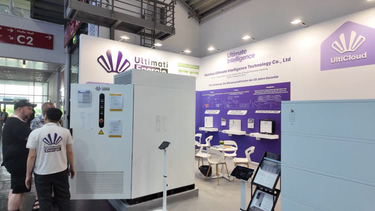
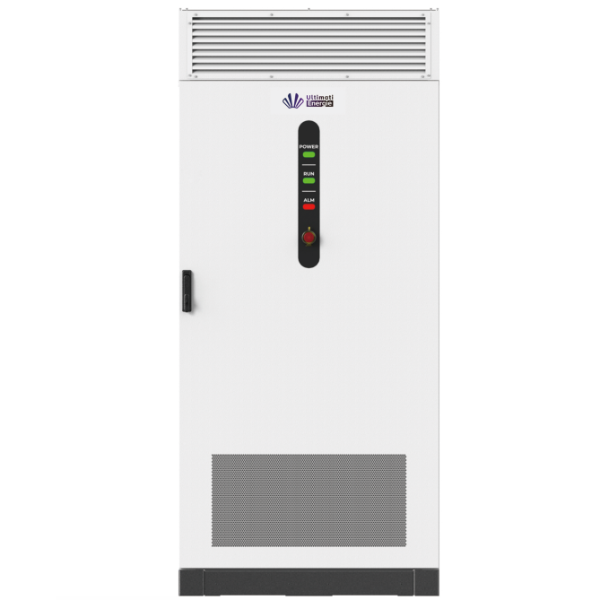
The ULTIBLOCK-TL261 from Ultimati Energie is built specifically for that practical boundary — a single integrated cabinet that packs grid-connected commercial storage into a footprint of just 1.35m².
What's Inside the Cabinet
ULTIBLOCK-TL261 highly integrates the battery pack, BMS, PCS, EMS, fire protection system, and liquid cooling system into one unit — so there's no need to source and integrate these components separately on site.
Key Features
- High Integration — battery, PCS, BMS, EMS, fire protection, and temperature control all in one cabinet covering just 1.35m² and standing 2.25m tall, a leading footprint-to-capacity ratio in its class.
- High Efficiency — an intelligent liquid-cooling temperature control strategy reduces parasitic power consumption, with system conversion efficiency up to 90%.
- High Safety — a three-level protection system continuously monitors for short circuit, over-current, over-voltage, and over-temperature conditions, backed by three-level fire protection (module level, cluster level, and water-based fire suppression) plus two-level explosion-proof design at both the module and cabinet level.
- Intelligent Management — a built-in EMS connects to a cloud platform for remote monitoring, remote configuration, revenue calculation, remote firmware upgrades, data analysis, and cloud-based fault warnings, with mobile app and local web access for on-site operation and maintenance.
Where It's Used
With a 0.5C discharge rate (125kW / 261kWh), the ULTIBLOCK-TL261 is configured for sustained, longer-duration discharge rather than short power bursts — a profile well suited to all-day peak shaving and demand charge management rather than brief power-quality events. The 400V AC connection and 1000×1350mm footprint let it install directly against a factory wall or in a compact outdoor utility area, making it a practical fit for:
- Factories and light-industrial sites running time-of-use arbitrage and demand charge management
- Commercial and industrial sites pairing storage with rooftop or ground-mount solar
- EV charging stations using storage to buffer fast-charging demand and avoid grid connection upgrades
The system has already been deployed in commercial installations across Europe, including a recent project in Spain.
FAQs
What's the real difference between utility-scale and C&I energy storage?
Utility-scale and large-scale storage systems are containerized and connect at medium voltage (10kV/35kV), typically above 5MWh. C&I storage is built into a single low-voltage cabinet connecting at 400V, typically up to about 2MWh — sized for what a single commercial or industrial site actually needs.
What size of battery system counts as C&I storage rather than utility-scale?
There's no strict cutoff, but systems connecting at 400V in an integrated cabinet, generally up to a few megawatt-hours, fall under C&I storage. Once a site needs medium-voltage connection and multiple container units, it moves into large-scale/utility-scale territory.
Can the ULTIBLOCK-TL261 be paired with on-site solar?
Yes. The built-in EMS supports integration with PV systems for solar self-consumption and time-shifting strategies, in addition to standalone grid-based arbitrage.
Why does liquid cooling matter for a C&I battery cabinet?
Liquid cooling holds cell temperatures within a tighter band than air cooling, which supports the system's rated cycle life (≥8,000 cycles) and the 90% conversion efficiency figure, while also enabling a more compact 1.35m² footprint than an equivalently sized air-cooled unit.
Is the ULTIBLOCK-TL261 suitable for EV charging sites?
Yes — its 125kW output and 0.5C profile are well matched to buffering the demand spikes created by DC fast chargers, helping EV charging operators avoid costly grid connection upgrades.
It is possible that you also want to know:
The Business Case for C&I Energy Storage in Europe: Unlocking the 2026 Value Stack
Peak Shaving in Energy Storage Systems
Why 261kWh Is Becoming the New Standard for Commercial Energy Storage in Europe

Ultimati Energie Deutschland GmbH is a Germany-based B2B energy storage system provider specializing in scalable residential and C&I battery storage solutions for European partners.
Become a Partner
Sales: +49 1624886367
Customer Support:
+49 15226994869
Address: Ober der Röth 4, 65824 Schwalbach am Taunus, Germany
Copyright © 2026 Ultimati Energie Deutschland GmbH All rights reserved.