

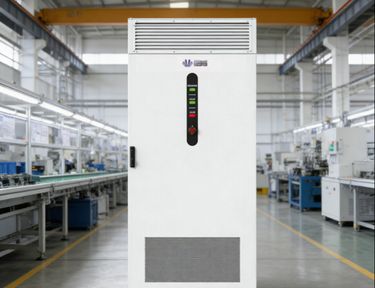
Why 261kWh Is Becoming the New Standard for Commercial Energy Storage in Europe
A practical perspective for installers and distributors
Across Europe’s commercial and industrial (C&I) energy storage market, system sizing is quietly becoming more standardized. Increasingly, installers are deploying C&I energy storage solutions around the 250–300kWh range, with 261kWh commercial energy storage systems emerging as a practical benchmark for many commercial applications.
This shift is not driven by marketing trends but by real deployment constraints — installation cost, operational efficiency, and project economics are pushing the market toward repeatable system configurations.
For distributors and installers, understanding this transition helps explain not only what systems are being installed, but why certain system designs are gaining traction faster than others.
What Is a 261kWh Commercial Energy Storage System?
A 261kWh commercial energy storage system refers to a mid-scale C&I battery configuration commonly deployed in a single integrated cabinet or modular cabinet-based architecture.
This capacity range is widely used in small and medium-sized commercial facilities to support peak shaving, load shifting, and on-site energy optimization.
Compared with smaller systems, it delivers more meaningful economic impact, while avoiding the installation complexity and cost escalation of larger multi-cabinet deployments.
Market Reality: Standardization Driven by Deployment Efficiency
Unlike residential storage, C&I ESS projects prioritize predictability and scalability.
Commercial customers typically seek solutions that can:
- reduce peak electricity costs
- improve solar self-consumption
- stabilize long-term operating expenses
In practice, commercial battery storage systems around 261kWh provide enough usable capacity to achieve measurable savings without introducing excessive upfront investment.
As electricity price volatility continues across Europe, installers increasingly favor configurations that balance performance with installation simplicity.
Installation Complexity Is Now a Key Decision Factor for C&I Energy Storage
One of the biggest changes in recent projects is that installers are no longer evaluating batteries purely by capacity or price.
Instead, integration level has become a decisive factor.
Traditional C&I BESS projects often require separate integration of:
- PCS
- BMS
- EMS
This increases commissioning time, wiring complexity, and potential failure points.
As a result, integrated all-in-one cabinet designs are gaining popularity, where core subsystems are pre-integrated within a single enclosure. By reducing onsite engineering work, installers can shorten deployment timelines and lower overall project CapEx — particularly important for small and mid-sized commercial installations.
Why 261kWh Fits Real Commercial Energy Usage
For a 261kWh commercial energy storage system, this capacity aligns closely with typical SME load profiles.
Systems in this range are large enough to support:
- peak shaving during high tariff periods
- valley filling strategies
- higher PV self-consumption rates
while remaining compact enough for installation in space-constrained commercial sites.
Advances in battery cell technology — particularly high-capacity LFP cells — now allow higher energy density within a single cabinet footprint. Compared with earlier 200kWh-class systems, newer configurations can deliver significantly more usable energy without increasing installation space.
Thermal Stability Becomes Critical in Commercial Energy Storage Operation
C&I storage systems operate differently from residential batteries. Many projects require daily cycling and extended operating hours, placing higher demands on thermal management.
Liquid cooling systems are increasingly adopted because they provide:
- more consistent temperature control
- improved system stability under continuous load
- reduced battery degradation over time
For installers and asset owners, this translates into longer service life and more predictable system performance — both essential for commercial ROI calculations.
Safety Expectations Are Rising in Commercial Deployments
As storage moves deeper into commercial environments, safety certification and protection architecture have become central purchasing criteria.
Modern C&I systems now incorporate multi-level protection strategies, including:
- module-level monitoring
- cluster-level protection
- cabinet-level fire suppression
combined with industrial-grade enclosure design to ensure safe operation in demanding environments.
For distributors, systems with integrated safety architecture reduce compliance risks and simplify project approval processes.
Designed Around Real C&I Energy Scenarios
The growing popularity of standardized cabinet sizes also reflects a shift toward application-driven design.
Rather than maximizing theoretical capacity, systems are increasingly optimized for real use cases such as:
- peak shaving
- load shifting
- on-site energy optimization
Solutions designed specifically for commercial and industrial scenarios enable faster commissioning and clearer value propositions for end customers.
Scalability Matters for Growing Commercial Energy Demand
Commercial energy demand rarely remains static. Businesses often expand operations or increase electrification over time.
Cabinet-based architectures supporting parallel expansion allow installers to deploy an initial system sized for current needs while enabling future capacity upgrades without redesigning the entire system.
This modular scalability reduces investment risk and improves long-term flexibility for both installers and end users.
The Bigger Picture: Standardization Signals Market Maturity
The rise of 261kWh-class systems reflects a broader evolution of Europe’s C&I storage sector.
The market is moving away from custom-engineered projects toward scalable, repeatable deployments — solutions that installers can implement efficiently and distributors can standardize across multiple projects. 261kWh commercial energy storage systems are increasingly treated as a standard building block across Europe’s C&I market.
For industry stakeholders, recognizing this shift is less about following a trend and more about aligning with how commercial energy storage is actually being deployed across Europe today.
If you are evaluating commercial energy storage projects in this capacity range, understanding how standardized systems are designed, integrated, and deployed can significantly reduce project risk.
You can explore how Ultimati Energie approaches commercial and industrial energy storage solutions—from system architecture to scalable deployment models—based on real European C&I applications.
FAQs About 261kWh Commercial Energy Storage
Is 261kWh commercial energy storage suitable for all commercial sites?
Not all sites require this capacity, but 261kWh fits a large share of European SMEs with predictable daily loads and time-of-use electricity tariffs.
Can a 261kWh commercial battery system be expanded in the future?
Yes. Most cabinet-based systems are designed for parallel expansion, allowing additional units to be added as energy demand grows.
Why is liquid cooling commonly used at the 261kWh system level?
At this capacity, daily cycling and continuous operation require tighter thermal control to maintain stability and reduce long-term battery degradation.

Ultimati Energie Deutschland GmbH is a Germany-based B2B energy storage system provider specializing in scalable residential and C&I battery storage solutions for European partners.
Become a Partner
Sales: +49 1624886367
Customer Support:
+49 15226994869
Address: Ober der Röth 4, 65824 Schwalbach am Taunus, Germany
Copyright © 2026 Ultimati Energie Deutschland GmbH All rights reserved.