

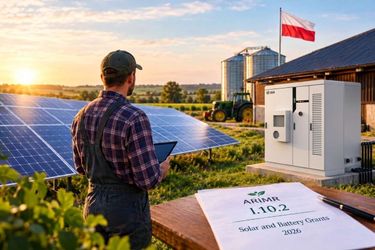
Poland’s ARiMR I.10.2 Funding 2026: Solar and Battery Planning for Farms
What farmers and installers should check before applying for Area B support—and why the funding threshold is only the starting point for a useful battery system.
Information checked: 27 October 2026. The published application window is 5 October–3 November 2026. Check ARiMR for amendments before submitting. This guide is not an eligibility decision or funding commitment.
A farm can have substantial electricity demand and still struggle to use all its solar generation when it is available. The relevant question is when that demand occurs. Cooling, ventilation, pumps and production equipment may create very different requirements over a day or a season.
Poland’s ARiMR I.10.2 funding gives eligible farms a route to support for a solar installation with battery storage under Area B. For a prospective applicant, however, choosing equipment and qualifying for assistance are two separate tasks. A system can look attractive commercially while its ownership arrangement, project timing or proposed use needs further examination.
The practical approach is to establish eligibility first, calculate assistance using the correct method, and then test whether the proposed solar and battery configuration fits the farm’s electricity profile. A subsidy should support a coherent project, not become the reason to purchase more equipment than the holding can use.
What Does Poland's ARiMR I.10.2 Funding Cover?
I.10.2 supports renewable energy and energy-efficiency investment in agricultural holdings under Poland’s CAP Strategic Plan 2023–2027. Area B includes PV with electricity storage and certain linked heat or energy-management investments; Area A concerns agricultural biogas, while Area C concerns building energy efficiency. See ARiMR’s programme overview.
This article addresses the Area B farm solar-and-battery route. It is not a guide to a general household storage subsidy or a grant for every business installing a battery in Poland. Buying equipment for a rural address does not, by itself, establish that the applicant or investment qualifies.
For an installer, that distinction should appear at the first enquiry. Establish who applies, which agricultural activities the installation serves, and how the electricity demand will be documented. Keep any household consumption visibly separate in the assessment rather than assuming that all consumption behind one connection receives identical treatment.
Who Can Apply, and When Is the Deadline?
The official 2026 Area B announcement sets the window at 5 October to 3 November 2026 inclusive, with electronic applications through Portal Rolnika.
Applicant requirements include agricultural eligibility, an EP identification number and an energy-efficiency training requirement. Individuals must be at least 18; companies and partnerships have additional conditions. Training may be completed through the undertaking described in the call, rather than necessarily before application. These are screening points, not a complete eligibility test.
Ask the farm’s adviser to check the applicant’s legal form and the supporting agricultural records before finalising the application. Where a spouse, partnership or company is involved, the documentation should identify the correct applicant and rights to carry out the investment.
With the published deadline approaching, portal access is an immediate practical issue. Confirm who will submit, whether an authorised adviser has the necessary access, and who will review the final attachments. Do not leave identity or representation questions until the last submission session.
An application deadline is not an equipment-installation deadline. Plan submission and delivery as separate milestones. Equally, submitting an application is not an award: the project should not be sold as “approved” before the responsible authority has made its decision.
Which Solar and Battery Conditions Shape the Design?
ARiMR’s Area B guidance and current application materials set out these important conditions:
- Generation capacity must fit documented farm consumption, with total electrical generation not exceeding 50 kW per electricity consumption point, or PPE.
- A PV purchase requires connected electricity storage of at least 0.5 kWh per kW of installed PV power.
- The supported energy is for the holding’s own needs.
- The operation must not start before the application date.
- Separate limits apply to generation serving a single-family dwelling: 10 kW and 20% of the holding’s total renewable electricity-generation power.
These conditions need to be read together. The 50 kW ceiling is not a recommendation to install 50 kW, and the battery ratio is not a complete sizing method. Check existing generation, the relevant PPE and any dwelling-related allocation with the adviser preparing the application.
Selection also uses a points system, with at least six points required for an operation to be eligible for an award. Ask the adviser to verify both the score and its supporting evidence; meeting that threshold does not guarantee funding.
Before signing an order or paying a deposit, obtain advice on what counts as starting the operation. Treating a supplier’s preferred booking process as automatically acceptable could create avoidable eligibility risk.
The current materials page lists PV information-card templates dated 26 October 2026. Use the latest official versions, not a form saved from an earlier enquiry.
How Much Support Is Available for Farm Solar and Batteries?
Area B assistance is capped at PLN 200,000 per beneficiary over the Strategic Plan period. The official announcement provides for support up to 65% of the relevant assessment base. Crucially, PV with electricity storage uses prescribed unit costs: PLN 3,940 per kW of PV and PLN 2,250 per kWh of battery capacity, rather than simply a percentage of the supplier’s invoice.
For the PV-and-battery component, the calculation can be illustrated as:
0.65 × [(PV power in kW × PLN 3,940) + (battery capacity in kWh × PLN 2,250)]
Illustrative arithmetic only: for an assumed 40 kW PV installation with 20 kWh of storage, the unit-cost base is PLN 202,600. Applying 65% gives PLN 131,690. This excludes general costs, other components and any applicant-specific adjustments; it is not an award estimate or confirmation that the configuration qualifies.
Keep the commercial budget separate. It should show the actual equipment, installation, electrical works, project preparation and other expenditure, with each item’s funding treatment checked by an adviser. A quotation above or below the unit-cost base does not change the arithmetic into a simple invoice reimbursement.
Also separate assistance from cash availability. Ask when expenditure must be paid, what documents support payment, and how the farm will cover its contribution and any non-supported items. Do not calculate the funding gap by assuming that the maximum award arrives when equipment is ordered.
Why the Minimum Battery Ratio Is Not the Final Battery Size
A 40 kW PV proposal reaches the published minimum storage ratio at 20 kWh. That says nothing, on its own, about the farm’s evening demand, available solar surplus or required discharge power. The ratio screens one programme condition; the operating profile should determine whether the installation is useful.
Start with interval consumption records and a realistic PV generation forecast. Compare working days, weekends and periods with different agricultural activity. An annual electricity total can support an initial discussion, but it hides whether solar production coincides with refrigeration, pumping or other controllable demand.
Measure the energy mismatch
Suppose a farm expects 16 kWh of usable solar surplus during a representative day and 24 kWh of demand after that surplus period. Increasing battery capacity beyond the available charging energy will not, by itself, fill the shortfall. Examine more than one representative day and account for conversion losses and the permitted operating window before comparing capacities.
Alternatively, a farm may have considerable midday consumption and little surplus. Direct use of solar electricity could already perform much of the work. The proposed battery still needs a documented operating role; equipment should not be sized by assuming that every generated kilowatt-hour passes through storage.
For a broader explanation of how storage shifts surplus solar generation to periods of higher demand, see our guide to increasing solar self-consumption. For a farm project, the assessment should also account for seasonal loads and the electricity that can be used directly during daylight hours.
Check power separately from energy
Battery capacity in kWh describes stored energy. Inverter power in kW describes the rate at which the system can charge or discharge. The preliminary arithmetic for a 6 kW load over two hours is 12 kWh, before allowances for losses and reserves. That calculation does not establish whether the inverter can start a motor or support a particular three-phase installation.
Ask for a load-specific assessment where pumps, compressors or other demanding equipment are involved. Usable capacity, continuous power and starting behaviour should be explained separately in the quotation.
Give the EMS a Farm-Specific Operating Plan
The energy management system should implement the agreed purpose of the installation. For this project discussion, begin with the farm’s own solar use and operational requirements. Do not insert export trading or grid-charging revenue into the funded business case without checking that those activities are compatible with the approved operation.
Ask the installer to show how the controller deals with four situations: a sunny day with substantial surplus, a production day with high daytime demand, a low-generation day and an unexpected increase in load. This reveals more than a generic dashboard demonstration.
For an example of PV generation integrated with commercial battery storage, see our PV and battery storage project in Friesland. The project illustrates how storage can support on-site energy use and peak-demand management, although its application and operating conditions differ from those of an agricultural holding in Poland.
Where equipment can operate at different times, consider whether moving its operation helps use solar electricity directly. Any schedule must respect the agricultural process: maintaining product temperature or meeting an irrigation requirement comes before an attractive energy chart.
Backup supply needs its own assessment. A PV battery should not be assumed to keep the farm operating during an outage. Request the supported circuits, transfer arrangement, available power and commissioning tests if backup is required. Separate that technical requirement from the question of whether particular expenditure receives assistance.
For existing PV installations, confirm the electrical and communication requirements before selecting a battery retrofit. Our guide to battery and inverter compatibility checks explains the key integration points installers should review before finalising a system configuration.
Prepare an Application That Agrees With the Equipment Proposal
A consistent document set is easier to review than a collection of individually plausible attachments. The proposed PV power, battery capacity, location, applicant and intended use should agree across the information card, technical description and commercial proposal.
ARiMR publishes the binding rules, instructions and forms on its Area B page. Have an adviser establish the exact attachment list for the applicant. The following is a project-preparation checklist, not a substitute for that official list:
- Applicant and site: confirm the legal applicant, property rights and permission to carry out the proposed works.
- Consumption evidence: reconcile bills, PPE identifiers, existing generation and the demand used in the design.
- Technical scope: identify PV, battery, inverter, protection, metering and any linked energy-management equipment.
- Funding calculation: distinguish unit-cost components from other assessed expenditure and check remaining assistance limits.
- Implementation sequence: confirm the application, contracting, installation and payment milestones before committing.
- Submission review: use current forms, confirm portal access and save the submission acknowledgement.
When approaching Ultimati Energie or an installation partner for a technical proposal, provide the farm’s load data, existing PV details and proposed operating role. Request configuration-specific documentation and compatibility evidence. Neither a brand name nor a product datasheet establishes approval under ARiMR I.10.2.
For projects with larger commercial or agricultural electricity demands, the ULTIBLOCK-TL261 commercial battery energy storage system is one product reference for technical evaluation. Its suitability must be assessed against the site's load profile, electrical configuration, applicable programme conditions and funding rules.
The strongest farm solar-and-battery proposal remains understandable without the subsidy headline. It explains where the energy comes from, when the holding uses it, what the battery contributes and how the applicant will finance and deliver the project. Poland’s ARiMR I.10.2 funding can then be assessed against that clearly defined scope.
Discuss Your Farm Solar and Battery Project
Before finalising a system proposal, prepare the farm's electricity consumption data, existing PV configuration, proposed battery capacity and intended operating requirements. Ultimati Energie can discuss the technical requirements and configuration options for your project.
For a project-specific discussion, contact Ultimati Energie for a technical assessment. Funding eligibility and approval remain subject to the applicable ARiMR rules and the responsible authority's decision.
Frequently Asked Questions
Is this the same as a household battery subsidy?
No. This guide concerns agricultural investment under I.10.2 Area B. Applicants should not use household funding assumptions to establish eligibility for a farm project.
Can I assume a battery-only retrofit qualifies?
No. The published electrical-storage route describes PV together with a battery. Have ARiMR or a qualified adviser assess a proposed retrofit rather than treating this article as approval.
Does “up to 65%” mean 65% of my installer’s price?
Not for the PV-and-electricity-storage component, which uses prescribed unit costs. Reconcile the assistance calculation with the actual project budget before making a purchasing decision.
Does meeting the minimum storage ratio guarantee a suitable system?
No. Test usable energy and charge/discharge power against solar surplus and farm demand. Technical suitability and programme eligibility require separate checks.
What if I read this after 3 November 2026?
Do not assume this call remains open. Check the linked ARiMR announcement for an extension, closure or a later round, and use the rules and documents applicable to that round.

Ultimati Energie Deutschland GmbH is a Germany-based B2B energy storage system provider specializing in scalable residential and C&I battery storage solutions for European partners.
Become a Partner
Sales: +49 1624886367
Customer Support:
+49 15226994869
Address: Ober der Röth 4, 65824 Schwalbach am Taunus, Germany
Copyright © 2026 Ultimati Energie Deutschland GmbH All rights reserved.