

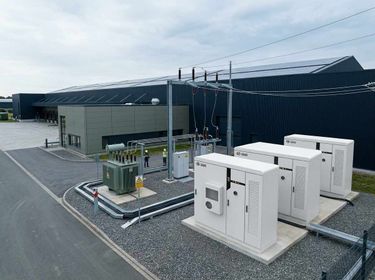
Germany’s AgNes Grid Fee Reform: What C&I Battery Buyers Should Check
A practical guide to separating proposed network charges from current project costs—and asking better questions before committing to a battery installation.
Policy status checked: 26 October 2026. This article provides project-planning guidance, not legal advice or a binding tariff assessment.
A commercial battery quotation can specify its power and usable energy precisely while leaving a much larger question unresolved: how will the project be charged for using the electricity network?
Germany’s proposed AgNes grid fee reform makes that question harder to leave until commissioning. For an EPC contractor or business buying a battery energy storage system, the immediate task is not to predict a universal future storage tariff. It is to establish which installation is being assessed, which electricity flows cross its network connection, and which assumptions belong in the investment case.
The distinction matters. A battery serving a factory behind a shared connection should not automatically be assessed like an independent trading asset. Nor does reducing the site's electricity purchases establish an entitlement to a network-charge exemption.
What Is Germany's AgNes Grid Fee Reform?
AgNes is the Bundesnetzagentur's proceeding on Germany's general electricity network tariff system, known in German as Allgemeine Netzentgeltsystematik Strom. It concerns how network use is charged, rather than the wholesale price of electricity or the battery's purchase price.
The regulator opened consultation on the complete draft on 6 August 2026. Its announced timetable envisages a framework decision at the end of 2026, further detailed determinations in 2027, and a new framework replacing the expiring StromNEV provisions from 2029. These milestones are described in the Bundesnetzagentur's English consultation announcement.
As of this review, the official proceeding page still presents a draft, not a final AgNes determination. Its published status is 21 September 2026, following the consultation deadline of 18 September. Buyers should check the current AgNes proceeding page before relying on a particular provision.
For a project moving through procurement now, this calls for two clearly labelled views: a cost assessment under the rules applicable to the project today, and a future sensitivity analysis. A proposed tariff should not silently become an existing operating expense—or a guaranteed saving.
Start With the Battery’s Connection, Not Its Cabinet Size
Before comparing network charges, prepare a single-line diagram showing the battery, production equipment, PV installation and connection to the public network. Add the relevant metering points and the permitted directions of flow. This is a more useful starting document than a product brochure.
The English AgNes draft, definitions and operative part 10, distinguishes solely grid-connected storage from co-located storage. It proposes an annual capacity-based financing tariff for solely grid-connected storage, calculated using the contractually agreed network connection capacity. Co-located installations are addressed together with the associated consumption or generation. These are draft distinctions, not confirmation of any individual project’s bill.
Commercial labels can obscure that difference. “C&I BESS” describes a market segment, but does not, by itself, determine regulatory classification. A similar cabinet could support manufacturing at one site and operate through a separate network connection at another.
Ask the network operator to assess the actual arrangement. Identify the connection user, the asset operator, the voltage level and whether the battery shares its connection with other equipment. Where an answer depends on a future determination, record that dependency instead of presenting an assumption as approval.
Which Network Costs Should a C&I Buyer Separate?
An investment model becomes difficult to audit when every network-related item appears under one “grid fee” line. Request a cost schedule that distinguishes the following items, even where some do not apply to the proposed installation.
| Cost or condition | Buyer’s question |
|---|---|
| Recurring network-use charges | What is the applicable tariff category, charging basis and billing period? |
| Connection and reinforcement expenditure | Which works and any construction cost contribution are included in the connection offer? |
| Metering and settlement | Which meters, data services and administrative costs are required? |
| Energy supply and market services | Which costs belong to the supplier or trading contract rather than network use? |
| Relief or transitional treatment | What is the documented basis, scope and duration of the assumed treatment? |
A construction cost contribution, often discussed as a Baukostenzuschuss or BKZ, should not disappear into an annual operating-cost estimate. Request its contractual basis and treatment separately. This article does not establish whether a particular contribution is payable.
Likewise, avoid placing an unverified national average into a project-specific tariff model. The relevant documents should identify the network operator, connection level, applicable year and assumptions used. Keeping the cost schedule explicit makes later updates possible without rebuilding the entire business case.
Why Charging for On-Site Use Is Different From Charging for Export
Draw two operating paths. In the first, electricity enters the battery and later supplies the business. In the second, imported electricity is stored and subsequently returned to the public network. Do not combine them into a single annual “battery throughput” figure when requesting a tariff assessment.
The draft’s operative part 10.2 provides for relief from specified energy-based network tariff components for separately measurable volumes withdrawn from the public network by co-located storage and subsequently fed back into it. This proposed treatment does not amount to an exemption from every network-related charge, nor does it justify treating all battery charging as exempt. Have an adviser verify the precise wording and references against the German text.
The planning implication is straightforward: the model must be able to distinguish energy destinations. If a quotation assumes financial relief for re-exported electricity, ask how those volumes will be established, who supplies the necessary data, and who is responsible when records are incomplete.
MiSpeL is a related but separate proceeding concerning the market integration of storage and charging points. The Bundesnetzagentur adopted its MiSpeL determination on 1 October 2026. Some implementation options remain subject to transitional arrangements or additional conditions. The determination does not make AgNes final or establish a blanket exemption for a commercial battery.
For the metering and export discussion, use the separate guide to MiSpeL and commercial battery grid export. Here, the task is to establish which network-cost assumptions the project can support.
Test the Site’s Import Profile Before Promising Network Savings
Consider an illustrative factory—not a measured customer case. Its production equipment needs 180 kW during a particular interval. If the battery charges at 70 kW at the same time, with no PV contribution and ignoring other loads, the combined import requirement is 250 kW.
That arithmetic does not establish a tariff, a penalty or a billable peak. It shows why checking the charging price alone is insufficient. Before approving the charging schedule, the project team needs to know whether the additional import fits the connection and how the applicable billing method treats it.
Now compare a schedule that delays part of the charging until production demand falls. It may provide the same stored energy before the next operating requirement, but with a different import profile. The correct comparison uses both schedules over the same period and includes the battery’s later discharge, not just its charging interval.
For each proposed operating strategy, request:
- The site import and export profiles before and after battery operation.
- The tariff calculation applied to each profile, including any capacity-related assumptions.
- The treatment of PV generation, auxiliary consumption and energy losses.
- The operating conditions under which the projected saving disappears.
This is a network-cost test, not a recommendation to maximise battery power or minimise it indiscriminately. A smaller charging limit may reduce one exposure while leaving too little energy for the next required task. The design needs to demonstrate both outcomes.
Do Not Assume an Existing or Planned Battery Is Automatically Exempt
Grandfathering should be treated as an evidence question. The regulator’s May policy explanation discussed preserving applicable existing storage arrangements under section 118(6) EnWG. However, an earlier policy summary is not a substitute for checking the subsequently published draft and the eventual decision.
Draft operative part 17.5 links storage transitional treatment to a final investment decision before publication of the determination, other statutory conditions and an evidence deadline of 31 March 2027. Under the draft definition, a final investment decision requires binding orders covering at least half of the investment volume, with withdrawal from the contracts involving significant financial damage. These proposed conditions require project-specific legal review.
As a practical safeguard, assemble the investment record while the project is progressing. Keep binding orders, relevant contract terms, dated approvals, commissioning records and network-operator correspondence together. Ask an adviser which documents are material; an internal budget approval should not simply be assumed to satisfy a regulatory investment test.
For an acquisition or expansion, also ask whether the treatment being discussed belongs to the original installation, the added equipment or the combined configuration. Request written clarification before assigning financial value to an assumed exemption. A supplier’s general assurance is not a substitute for that assessment.
Keep Dynamic Network Tariffs Separate From Dynamic Electricity Prices
A dynamic electricity supply contract concerns the price paid for supplied energy. A dynamic network tariff concerns network use. They are different inputs, and a controller should not be described as “AgNes-ready” merely because it can follow a day-ahead electricity price.
The draft treats dynamic network tariffs as a separate implementation track requiring further determinations. For storage connected at the network and transformation levels specified in operative part 12.2, the draft envisages introduction no earlier than 1 January 2030 and no later than 1 January 2033, subject to the required further determination. Buyers should therefore avoid assuming that dynamic network tariffs will apply universally from 2029 or operate identically at every connection.
Instead of buying a readiness label, request a demonstration of the proposed control architecture. Can the site import limit be configured independently of the market-price signal? Who can change tariff parameters? Can the controller record the instruction, measured response and reason for a constraint?
Also identify the decision hierarchy. If a trading service requests charging while the site controller is restricting import, the contract and technical design should specify which instruction takes priority. This is a procurement requirement to agree, not a claim that every existing EMS already supports it.
Six Questions to Resolve Before Ordering a German C&I BESS
- Which connection arrangement has been assessed? Attach the relevant single-line diagram and identify any shared loads or generation.
- Which current tariff supports the base case? Record its source, year, charging basis and any special agreement.
- Which conclusions depend on AgNes? Label draft assumptions and assign responsibility for reviewing the final decision.
- Which energy flows support any claimed relief? Identify the measurement and settlement evidence needed.
- What happens when the battery cannot follow its schedule? Test reduced availability, an unexpected production peak and delayed recharging.
- Who updates the assessment? Agree who revises the tariff model, control settings and contract assumptions before commissioning.
These questions can form part of a technical enquiry to Ultimati Energie for a German commercial storage project. Provide the site load profile, network connection documents, planned PV configuration and intended battery uses. Any tariff or exemption assessment should be confirmed separately with the responsible network operator and qualified advisers.
Germany’s AgNes grid fee reform is a reason to improve the evidence behind a BESS purchase, not to attach a speculative saving to every quotation. A useful proposal shows the present position, identifies the assumptions that may change, and leaves a clear route for updating the design when the final rules are available.
Frequently Asked Questions
Is AgNes already a final rule?
Not in the official material checked for this article on 26 October 2026. The proceeding page presents the consultation draft. Check for a final determination before relying on proposed provisions.
Will AgNes affect every commercial battery in the same way?
Do not assume uniform treatment. The connection arrangement, associated consumption or generation, applicable tariff and any transitional eligibility need to be assessed for the individual project.
Does installing behind the meter remove network charges?
The physical location alone does not establish an exemption. Map the imported electricity and its eventual destination, then request an assessment of the applicable charging treatment.
Can a battery project still be evaluated before AgNes is final?
Yes. Use applicable rules for the current assessment and clearly labelled alternatives for uncertain future conditions. Do not make an unconfirmed exemption or future tariff reduction essential to an otherwise unexplained investment case.
What should a supplier provide about future network tariffs?
Request transparent assumptions and evidence of the proposed system’s control capabilities. A supplier should distinguish equipment performance from a tariff interpretation that requires confirmation by the network operator or an adviser.

Ultimati Energie Deutschland GmbH is a Germany-based B2B energy storage system provider specializing in scalable residential and C&I battery storage solutions for European partners.
Become a Partner
Sales: +49 1624886367
Customer Support:
+49 15226994869
Address: Ober der Röth 4, 65824 Schwalbach am Taunus, Germany
Copyright © 2026 Ultimati Energie Deutschland GmbH All rights reserved.