

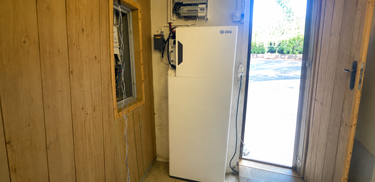
MiSpeL Battery Storage Germany: How to Meter PV Systems That Charge From the Grid
MiSpeL is designed to let a German PV battery use both solar electricity and grid electricity without treating every later export as if it had the same regulatory origin. The practical challenge is allocation: installers must match the physical system, settlement meters and calculation method to either the Abgrenzungsoption or the Pauschaloption. An energy management system can schedule grid charging, but it cannot replace the measurements and market processes required for settlement.
Regulatory status: The Bundesnetzagentur published its latest MiSpeL working documents on 5 August 2026 for early market information. They are not the final determination. The authority currently plans effectiveness from 1 October 2026, while the draft tenor shows that date in brackets and includes transitional arrangements. Treat this guide as design preparation, not legal advice or proof of compliance.
Last reviewed: 11 August 2026
The short answer for installers
Choose the Abgrenzungsoption when the project needs a precise, formula-based allocation of measured energy flows or has a configuration that does not fit the simplified cases. Consider the Pauschaloption only when the complete eligibility conditions are met, including the 30 kWp solar limit, common operator identity, permitted generation technologies, direct marketing and a consistent P-formula and meter concept. Both routes still depend on quarter-hourly, metering-law-compliant grid data.
Contents
1.Current MiSpeL status
2.The allocation problem
3.Abgrenzungsoption vs Pauschaloption
4.Pauschaloption eligibility checks
5.15 kWp worked design example
6.Metering and data responsibilities
7.RE-HA1 and UltiCloud
8.Frequently asked questions
Is MiSpeL final, and when could it take effect?
No. On 5 August 2026, the Bundesnetzagentur published a new working status consisting of a draft tenor, Annex 1 for the Abgrenzungsoption and Annex 2 for the Pauschaloption. The publication is intended to inform the market and support coordination with the parallel AgNes process; it is not a renewed consultation or a final determination.
The authority says MiSpeL is currently planned to become effective on 1 October 2026. The working tenor places the date in brackets. It also proposes that, until 30 September 2027, claims and assignments would be usable only with the agreement of the relevant network operator and metering point operator. These bracketed dates and transitional conditions must be checked again against the final text before commissioning, contracting or making a compliance claim.
There is another timing issue for the Pauschaloption: the August working draft states that its use is subject to the European Commission’s state-aid approval of Section 19(3c) EEG. A project schedule should therefore separate technical readiness from legal availability.
How MiSpeL battery storage in Germany changes grid charging
A battery can receive electricity from an on-site PV array and from the public grid. After both quantities enter the same storage system, the physical electrons are not traceable by origin. Regulatory settlement nevertheless has to distinguish quantities that may qualify for an EEG market premium from quantities associated with earlier grid imports and possible levy relief.
Under the existing Ausschließlichkeitsoption, support for electricity exported after storage depends on exclusive storage of eligible renewable electricity. Grid charging breaks that exclusivity. MiSpeL is intended to add two alternatives that mathematically allocate mixed quantities instead of requiring physical separation:
- förderfähige Netzeinspeisung: the part of grid export that can be treated as eligible for the applicable EEG support route;
- saldierungsfähige Netzeinspeisung: the part relevant to reducing levies on qualifying grid electricity used for intermediate storage;
- privilegierungsfähige Stromspeicherverluste: qualifying storage losses where the selected case and rules require their calculation.
The governing question is therefore not simply, “Can this inverter charge from the grid?” The project must ask, “Can the selected meter architecture produce every value required by the applicable MiSpeL formula, and can the responsible market parties process those values?”
What is the difference between the Abgrenzungsoption and Pauschaloption?
Installer comparison of the two MiSpeL allocation routes in the August 2026 working draft | ||
| Design question | Abgrenzungsoption | Pauschaloption |
| Allocation approach | Detailed allocation using measured flows and case-specific A-formulas | Simplified allocation using statutory assumptions, limits and case-specific P-formulas |
| Measurement resolution | Quarter-hourly, metering-law-compliant values for grid exchange and other required points | Quarter-hourly, metering-law-compliant grid import and export values remain required |
| Calculation period | Relevant quantities are calculated by calendar month from 15-minute values, then aggregated for annual settlement | Simplified formulas use annual limits and annual determinations, while individual 15-minute values still affect parts of the calculation |
| Solar capacity limit | Not restricted by the Pauschaloption’s 30 kWp threshold | Total qualifying solar capacity behind the feed-in point must not exceed 30 kWp under the stated counting rules |
| Typical meter effort | Potentially higher; internal flow measurements may be required by the case | Lower in eligible standard cases, but not “meter-free” |
| Best fit | Complex configurations or projects that need more exact allocation | Defined small-solar configurations satisfying every Annex 2 condition |
| Common design error | Selecting a formula without the matching physical meter points | Assuming any battery paired with less than 30 kWp of PV qualifies automatically |
How the Abgrenzungsoption works
The August 2026 working Annex 1 uses case-specific formulas to allocate measured electricity flows. Grid import and export must be recorded and balanced in 15-minute resolution. Additional measurement points depend on the selected configuration, such as multiple generators, separately supplied loads, batteries or bidirectional charging points.
Annex 1 now calculates the relevant quantities for each calendar month from the underlying 15-minute values. Monthly results are then summed for the annual final settlement. A monthly balancing period does not allow the installer to substitute a monthly inverter total for the required quarter-hourly settlement measurements.
How the Pauschaloption works
The August 2026 working Annex 2 simplifies allocation for defined arrangements with solar installations of no more than 30 kWp. Its P1 base case shows one solar installation, a battery and other consumption behind the feed-in and withdrawal point. The draft also provides cases for charging points, combined battery and charging-point arrangements, multiple solar installations and a separately supplied heat pump.
“Simplified” describes the formula and meter architecture, not an exemption from settlement data. Annex 2 still requires grid import and export to be captured and balanced in quarter-hourly resolution using metering-law-compliant equipment. The applicable P-formula must remain paired with its matching meter concept.
Does a PV battery below 30 kWp automatically qualify for the Pauschaloption?
No. The 30 kWp figure is a limit on the combined installed solar capacity under the draft’s counting rules; it is not a battery power or capacity threshold. For a configuration with a market-premium-supported solar installation, the August working draft lists several additional conditions. Installers should check all of them before treating a project as a P1 case:
1.Permitted generation: generation behind the feed-in point must come only from solar installations, batteries and qualifying charging points.
2.Common operator: the same plant operator must operate all solar installations, batteries and charging points behind the feed-in point.
3.Solar limit: the relevant installed solar capacities must total no more than 30 kWp, subject to the draft’s specific treatment of plug-in solar devices.
4.Direct marketing: the relevant assets must be assigned to a direct-marketing route. At least one solar installation must use subsidised direct marketing with a market premium for the supported case.
5.No network-operator purchase at that point: feed-in remuneration, free acceptance and the tenant-electricity surcharge are excluded for the listed configuration.
6.One method per point: the complete grid export and grid import at the relevant points must be treated consistently under Annex 2; the same quantities cannot simultaneously use the other MiSpeL options.
7.Balancing: the complete export must be assigned to the required direct-marketing balancing account or sub-account.
8.Timing and approval: the final determination, transition and European Commission state-aid approval must allow the option to be used.
A second practical nuance concerns extra devices. A heat pump on the ordinary household supply can remain part of “other consumption” in a P1-style configuration. A heat pump with a separate supply contract and separate withdrawal point can move the design to the P5 special case. Similarly, multiple solar installations require the P4 or P4-variant logic rather than pretending the one-solar P1 diagram still applies unchanged.
Worked design example: 15 kWp PV with a grid-charging battery
Consider a German residential project with 15 kWp of rooftop PV, a three-phase battery, household loads, a heat pump, a dynamic electricity tariff and an intention to charge during selected low-price intervals. The equipment may be technically capable of this strategy, but hardware capability does not determine the regulatory case.
Resolve the design in the following order:
1.Define the commercial claim. Is the battery only reducing household grid consumption, or could it export stored electricity while the operator claims an EEG market premium and levy treatment?
2.Map every asset behind the connection point. Record all solar installations, batteries, charging points, other generators and separately supplied loads. Confirm operator identity for each asset.
3.Select the candidate MiSpeL case. One solar installation, one battery and ordinary consumption resemble P1 or the corresponding A-case. A separately supplied heat pump, additional solar installation or bidirectional charger changes the analysis.
4.Draw the settlement meter concept. Mark every import, export and internal flow required by the selected formula. Do not use an inverter dashboard value where the draft requires a metering-law-compliant settlement value.
5.Confirm market roles. Identify the meter operator, network operator, electricity supplier, direct marketer, balancing-account party and the party that applies and validates the MiSpeL formula.
6.Check transition readiness. Confirm whether the final rules are effective and whether the network and metering operators agree during any transitional period.
7.Only then configure the EMS. Price-based charging, PV forecasts and reserve settings should operate inside the approved commercial and metering design.
This sequence prevents a common failure: commissioning a technically functional grid-charging battery and discovering later that the project’s meters, marketing arrangement or asset ownership do not support the intended settlement treatment.
What data does a MiSpeL PV battery project need?
A reliable project separates settlement evidence from operational telemetry. The two data sets can interact, but they do not perform the same legal or commercial function.
Four data layers for a grid-charging German PV battery | |||
| Data layer | Purpose | Typical source | Installer question |
| Grid exchange | Records import and export at the relevant connection point | Metering-law-compliant settlement meter | Can the responsible market party receive balanced 15-minute values? |
| Internal flows | Supplies case-specific inputs where the selected A- or P-formula requires them | Approved internal meter points | Is any required flow hidden behind an unmeasured path? |
| Battery operation | chedules charging, discharge, reserve and state of charge | PCS, BMS and EMS telemetry | Can commissioning logs prove the control behaviour without presenting telemetry as settlement data? |
| Regulatory allocation | Calculates support-eligible and levy-relevant quantities | Selected MiSpeL formula and market process | Who calculates, validates, transfers and retains the result? |
At 02:00, an EMS may command the battery to charge because the tariff is low. At 13:00, PV may supply the home and battery. At 19:00, the battery may serve household loads or export. An EMS log describes those commands and device states. MiSpeL settlement instead allocates relevant quantities from approved measurements and formulas; it does not follow individual electrons through the battery.
Before handover, provide a single-line diagram naming every settlement-relevant measurement point, a data register showing resolution and ownership, the selected MiSpeL case and formula version, and a change-control rule. Adding another PV installation, a separately metered heat pump or bidirectional charging later can change the applicable case even when the battery hardware stays the same.
Where do RE-HA1 Premium Edition and UltiCloud fit?
For projects in this residential power range, the RE-HA1 Premium Edition is offered with 8, 10 and 12 kW power options and nominal battery configurations from 7.6 to 22.7 kWh. Its integrated PCS, BMS and EMS architecture can execute charging and discharging schedules without requiring the installer to assemble independent battery-control layers.
UltiCloud provides the operational software layer. It can use PV production, grid exchange, battery state of charge, household demand, tariff structures and weather-related forecasts to inform operating modes and schedules. Those capabilities are relevant to the flexibility that MiSpeL is intended to enable.
The compliance boundary must remain explicit:
- RE-HA1 provides the battery and power-conversion platform.
- UltiCloud controls and monitors operation.
- The approved meter concept supplies settlement-relevant measurements.
- The selected MiSpeL formula and market parties allocate and settle the quantities.
Neither the product nor the app should be described as a MiSpeL compliance certificate. A compliant outcome remains site-specific and depends on the final determination, physical topology, meter concept, asset ownership, direct-marketing setup, data exchange and acceptance by the relevant parties.
Installer handover checklist
- Record the version and date of the MiSpeL documents used for design.
- Confirm whether the final determination is effective and whether transitional consent is required.
- List every generator, battery, charging point and separately supplied load behind the relevant points.
- Confirm the operator of each solar installation, battery and charging point.
- Document whether the project uses direct marketing, feed-in remuneration or another route.
- Select one applicable MiSpeL case and pair its formula with the matching meter concept.
- Verify quarter-hourly, metering-law-compliant data availability and balancing responsibilities.
- Keep EMS telemetry clearly separated from settlement evidence.
- Define who calculates, validates and submits the monthly or annual allocation results.
- Require regulatory reassessment after any material system extension or market-role change.
Frequently asked questions
Is MiSpeL already final?
No. The Bundesnetzagentur published a working status on 5 August 2026. The authority currently plans effectiveness from 1 October 2026, but installers must check the final determination, final dates and transitional conditions before relying on it.
Does every PV battery below 30 kWp qualify for the Pauschaloption?
No. The threshold applies to relevant solar capacity, and it is only one condition. Permitted generation, common operator identity, direct marketing, consistent treatment of all grid exchange, balancing arrangements, the selected meter concept and legal timing also matter.
Does the Pauschaloption still require 15-minute meter data?
Yes. The August 2026 working Annex 2 requires grid import and export to be captured and balanced in quarter-hourly resolution using metering-law-compliant equipment. Simplified formulas do not mean monthly-only inverter data is sufficient.
Can an EMS or battery app replace MiSpeL metering?
No. An EMS can schedule charging and discharge and record operational telemetry. Settlement depends on the approved measurements, formula, balancing and market processes. The two layers should exchange relevant information without being treated as legally interchangeable.
Does a heat pump automatically disqualify a P1 configuration?
No. A heat pump on the ordinary supply can be treated as other consumption in the base arrangement. A separately supplied heat pump with its own withdrawal point can require the P5 special case and an additional meter architecture.
Can RE-HA1 Premium Edition guarantee MiSpeL compliance?
No battery product can guarantee site-level MiSpeL compliance by itself. RE-HA1 and UltiCloud can provide storage and control capabilities, while compliance depends on the final rules, project topology, metering, direct marketing, data handling and acceptance by the responsible market parties.
Conclusion
MiSpeL turns grid charging from a device feature into a metering, allocation and settlement design task. For MiSpeL battery storage in Germany, installers should identify the commercial claim, map the complete site, choose the applicable case, design the matching meter concept and assign market-data responsibilities before programming price-based charging. The Pauschaloption may reduce complexity for eligible small-solar configurations, but 30 kWp alone is not a qualification test. RE-HA1 Premium Edition and UltiCloud can execute the operational strategy; the approved measurements and MiSpeL calculations determine the settlement outcome.
Primary sources and product references
- Bundesnetzagentur: MiSpeL procedure and August 2026 working status
- MiSpeL working tenor, 5 August 2026
- MiSpeL working Annex 1: Abgrenzungsoption, 5 August 2026
- MiSpeL working Annex 2: Pauschaloption, 5 August 2026
- German Renewable Energy Sources Act (EEG), Section 19
- Energy Financing Act (EnFG), Section 21
- Ultimati Energie: RE-HA1 Premium Edition product page
- Ultimati Energie: UltiCloud energy management apps
This article is a technical overview of a regulatory working draft and is not legal advice. Verify the final determination and project-specific requirements with the responsible network operator, metering point operator, direct marketer and qualified legal or regulatory advisers.

Ultimati Energie Deutschland GmbH is a Germany-based B2B energy storage system provider specializing in scalable residential and C&I battery storage solutions for European partners.
Become a Partner
Sales: +49 1624886367
Customer Support:
+49 15226994869
Address: Ober der Röth 4, 65824 Schwalbach am Taunus, Germany
Copyright © 2026 Ultimati Energie Deutschland GmbH All rights reserved.