

How to Size a Home Battery After Dutch Net Metering Ends in 2027
Short answer: size a home battery from the solar energy a household can repeatedly move from high-production hours to later demand, not from annual PV generation alone. For each day, use the lower of chargeable PV surplus and residual demand, convert that target into usable battery energy, allow for reserve and losses, and then size inverter power separately from capacity.
What Changes When Dutch Net Metering Ends?
The Dutch salderingsregeling ends on 1 January 2027. From that date, households and other small users can no longer offset electricity exported at one time against electricity imported at another. Imported electricity is billed separately, including the applicable energy tax and VAT, while exported electricity receives a supplier compensation.
The Dutch government explains that, until 2030, export compensation must be at least 50% of the electricity supply price excluding energy tax and VAT. The ACM consumer guidance also notes that suppliers may continue to charge feed-in costs. Those costs can sometimes exceed the export compensation, so installers should not model exported energy as if it had one fixed national value.
Electricity generated and consumed behind the meter remains different: the household does not buy that electricity from its supplier and therefore does not pay supplier charges or tax on it. This makes timing more important. A battery can increase solar self-consumption by storing some midday surplus for later use, but its value depends on how often it can complete that shift.
Design implication
The correct question is not "How much solar does this roof generate per year?" It is "How many kilowatt-hours can this household repeatedly charge and use within the battery's operating window?"
Why Annual PV Yield Is Not Enough
Annual generation and annual consumption are useful screening figures, but they hide the timing mismatch that a battery is intended to solve. Two homes can each generate 8,000 kWh and consume 6,000 kWh per year while having very different storage needs. One may have a heat pump and substantial evening demand; the other may use most electricity while the sun is shining.
A design based only on annual figures can oversize the battery for summer peaks, underestimate winter grid imports, or confuse total consumption with shiftable consumption. In the Netherlands, seasonal production makes this especially important. Milieu Centraal notes that summer surplus can exceed the storage capacity of a typical home battery, while winter PV production may be too low to fill it.
Minimum data set for a credible design
- PV generation by interval: preferably 15-minute data for at least one representative year.
- Household consumption by interval: aligned to the same timestamps as the PV data.
- Future load changes: EV charging, heat pump use, electric cooking, cooling or planned occupancy changes.
- Customer priorities: solar self-consumption, backup reserve, dynamic-tariff charging, export limiting or a combination.
- Contract inputs: import tariff, export compensation, feed-in costs, time-varying prices and any fixed charges.
- Hardware constraints: usable energy, charge and discharge efficiency, maximum power, phase arrangement and reserve settings.
If measured PV data are unavailable for a new system, combine a location-specific PV model with a measured household load profile. Keep the uncertainty visible and rerun the analysis when real operating data become available.
A Five-Step Home Battery Sizing Method for the Netherlands
Step 1: Define the battery's primary job
Start with a written operating objective. A battery sized mainly for solar self-consumption is not automatically sized for whole-home backup or energy-market trading. If several objectives apply, model each one separately and identify which objective sets capacity, power and reserve.
- Solar shifting: preserve enough empty capacity to absorb recurring PV surplus.
- Backup: protect a stated amount of usable energy for selected loads and duration.
- Dynamic tariffs: charge only when the expected price difference covers conversion losses, degradation assumptions and contract-specific charges.
- Export limiting: confirm whether the required charge power is high enough to absorb short PV peaks, not just daily energy.
Step 2: Calculate chargeable PV surplus
For each interval, calculate the energy that remains after simultaneous household demand:
PV surplus (kWh) = max(PV power - household load, 0) x interval hours
For 15-minute data, interval hours equal 0.25. Sum the positive intervals within the proposed charging window. The result is the PV energy that could reach the battery before charge losses and power limits are applied.
Step 3: Calculate later residual demand
Next, calculate the demand that remains after PV output falls:
Residual demand (kWh) = max(household load - PV power, 0) x interval hours
Use the actual discharge window rather than assuming all overnight consumption should be battery supplied. Some loads may intentionally remain on the grid, and backup energy may be protected from normal cycling.
Step 4: Set the daily shift target and convert it to usable energy
For a simple daily screen, the solar shift opportunity is the lower of chargeable PV surplus and later residual demand:
Daily solar shift target = min(chargeable PV surplus, later residual demand)
Do not select the largest day in the data set automatically. Compare candidate capacities across the full chronological year and report how often each additional capacity step is used. A larger system is justified only when the extra usable energy serves a defined need often enough to support the customer's technical and economic objectives.
If the target is measured as AC energy delivered to household loads, convert it into the usable battery energy required at the start of discharge:
Required usable battery energy = target AC energy / discharge-path efficiency
If a fraction of published usable capacity must remain protected as reserve:
Required published usable capacity = target AC energy / (discharge efficiency x (1 - reserve fraction))
Charge efficiency should be checked separately to confirm that the available PV surplus can put enough energy into the battery. Use project-specific datasheets and settings; do not reuse illustrative percentages as design guarantees.
Step 5: Size inverter power independently
Energy capacity answers "for how long?" Power answers "how much at once?" Review the interval-level load duration curve, not only the single highest spike. Then decide which loads the battery should serve and whether short peaks can remain grid supported.
Illustrative evening load check
| Load | Example demand |
| Cooking | 2.5 kW |
| Heat pump | 2.0 kW |
| Household base load | 0.5 kW |
| Other short-duration loads | 1.0 kW |
| Potential simultaneous demand | 6.0 kW |
The final power selection must also consider three-phase load distribution, the grid connection, backup circuits, motor starting currents, export restrictions and the exact grid-code requirements that apply to the installation. Battery capacity does not determine inverter power by itself.
Worked Example: 10 kWp PV With 10 kWh of Later Demand
Consider an illustrative three-phase Dutch home with the following design inputs:
- 10 kWp of rooftop PV;
- 16 kWh of chargeable PV surplus on a representative clear spring day;
- 10 kWh of evening and overnight residual demand;
- approximately 6 kW of simultaneous evening load;
- a 10% reserve setting;
- an illustrative 92% discharge-path efficiency.
The initial solar shift target is:
min(16 kWh, 10 kWh) = 10 kWh delivered to later loads
Without a protected reserve, the battery would need approximately 10.9 kWh of usable stored energy at the start of discharge:
10 / 0.92 = 10.87 kWh usable
With 10% of published usable capacity protected:
10 / (0.92 x 0.90) = 12.08 kWh published usable capacity
This is a screening calculation, not the final recommendation. The next step is to replay the full year with the candidate battery's state of charge, charge and discharge power, efficiencies and reserve settings.
Compare candidate sizes using usable energy
The official RE-HA1 Premium Edition specifications list nominal system energy of 7.6, 11.4, 15.2, 19.0 and 22.7 kWh, with corresponding usable energy of 7.2, 10.8, 14.4, 18.0 and 21.7 kWh under the stated test conditions. Use the usable figure for the first comparison and then apply the configured reserve.
Illustrative comparison of the two closest RE-HA1 configurations
| Check | 11.4 kWh nominal | 15.2 kWh nominal |
| Published usable energy | 10.8 kWh | 14.4 kWh |
| Usable after 10% reserve | 9.72 kWh | 12.96 kWh |
| Illustrative AC energy after 92% discharge efficiency | About 8.94 kWh | About 11.92 kWh |
| Interpretation for the 10 kWh target | Likely leaves some later demand on the grid when reserve is protected | Covers the illustrative target with operating margin |
| Evidence needed | Frequent use near the upper usable limit | Enough measured days that use the additional 3.8 kWh |
The 15.2 kWh configuration is not automatically the better investment. It is the technically safer fit for this single target day with the stated reserve and efficiency, but its extra capacity must still be tested across spring, summer, autumn and winter. If evening demand is usually lower than 10 kWh, the additional energy may remain unused. If the home has consistent heat-pump demand or a defined backup requirement, the headroom may be valuable.
Run a chronological annual simulation
For each 15-minute interval, update state of charge in sequence. Apply chargeable surplus, charging efficiency, maximum charge power, usable-energy ceiling, residual demand, discharge efficiency, maximum discharge power and reserve floor. Do not average PV and load profiles before this calculation; averaging removes the timing relationship the battery is meant to address.
For every candidate size, report at least:
- PV energy charged into the battery;
- battery energy delivered to household loads;
- remaining grid export and grid import;
- energy rejected because the battery was full;
- charge or discharge curtailed by the kW limit;
- annual battery throughput;
- days on which the larger capacity provided additional useful energy;
- the effect of reserve and dynamic-tariff rules on solar headroom.
The most useful comparison is incremental utilization: how often and by how much the next capacity step changes grid import, export or backup coverage. That makes the recommendation traceable to customer data instead of a rule of thumb.
Model the Energy Contract Before Claiming Savings
Ending net metering increases the relevance of self-consumption, but it does not establish a universal battery payback period. The result varies with the supplier contract and operating strategy. A credible proposal should use the customer's actual terms and show at least a base case and a sensitivity case.
- Imported electricity: use the contract rate and the applicable tax and VAT treatment.
- Exported electricity: use the stated compensation and separately model feed-in costs.
- Dynamic charging: include price spread, conversion losses and any supplier or platform restrictions.
- Battery use: include realistic availability, reserve, degradation assumptions, maintenance and financing where relevant.
- Future changes: test EV charging, heat-pump demand and contract renewal rather than treating today's profile as permanent.
Do not present gross import-versus-export price spread as guaranteed battery revenue. The ACM advises consumers to compare contract conditions carefully, and the applicable fees and compensation can change. State the tariff date and source used in every proposal.
Translating the Sizing Result Into an RE-HA1 System Design
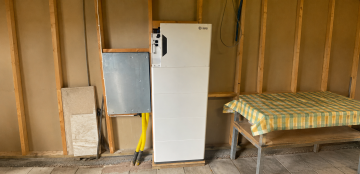
The RE-HA1 Premium Edition is listed by the manufacturer as a three-phase, high-voltage, all-in-one residential storage system with 8, 10 and 12 kW power classes and five energy configurations from 7.6 to 22.7 kWh nominal. That range allows capacity and power to be selected as two separate design decisions.
For the worked example, the energy calculation narrows the initial comparison to 11.4 and 15.2 kWh. The 6 kW simultaneous load sits below the listed 8 kW entry power class, but the final inverter selection still requires checks for peak loads, phase balance, backup output, PV input, grid connection and local acceptance of the exact model. A European grid standard listed on a product page is not, by itself, proof of project approval by a Dutch distribution system operator.
After hardware selection, the energy management strategy should protect the design intent. UltiCloud supports monitoring and operating modes including self-consumption, time-of-use operation and feed-in limitation. For a solar-shifting project, the control plan should preserve enough empty capacity for the next PV window and enough stored energy for the later demand used in the sizing calculation.
Grid charging should be treated as a separate use case. It can be evaluated when a low-price window is expected, but it should not fill capacity that would otherwise absorb higher-value solar energy the following day. See the related guide on when to charge a home battery on dynamic tariffs and the technical overview of AC-coupled battery storage.
Installer decision rule
Capacity follows repeated energy utilization. Inverter power follows simultaneous loads and grid constraints. Reserve follows backup requirements. The EMS then operates within those limits.
Frequently Asked Questions
Does Dutch net metering definitely end in 2027?
Yes. The national salderingsregeling ends on 1 January 2027. Imported and exported electricity will no longer be offset under the statutory scheme. Check any contract that runs across the change date because supplier terms still matter.
How many kWh should a Dutch home battery have?
There is no reliable national default. Calculate the lower of recurring chargeable PV surplus and later residual demand, convert the result into required usable energy, and test candidate sizes across a chronological year. Capacity should reflect repeated use, not the largest summer surplus.
Should a battery be sized from annual PV generation?
No. Annual generation is a screening input, not a final sizing input. It does not show whether surplus solar and household demand occur at times that allow the battery to charge and discharge.
Is nominal capacity the same as usable capacity?
No. Nominal or system energy is the total stated capacity, while usable energy is the portion available under the manufacturer's operating limits and test conditions. Compare usable energy first, then account for the reserve setting and discharge losses.
Will a home battery eliminate solar export?
Usually not. Summer surplus can exceed the battery's capacity or charge power, while winter PV production may be insufficient to fill it. The objective should be a measured reduction in unattractive export, not a promise of zero export.
Is a larger battery always better after the salderingsregeling ends?
No. Extra capacity only adds value when the home can charge and use it, or when it serves a defined backup or tariff use case. Compare incremental annual utilization, not capacity alone.
Can a home battery charge from the grid on a dynamic tariff?
Some systems can, but technical capability does not guarantee savings. Model the price spread, losses, contract fees, reserve and next-day solar forecast. Grid charging should not displace more valuable PV charging without a clear reason.
Conclusion
After Dutch net metering ends, home battery sizing should be based on time-matched energy flows. Calculate interval-level PV surplus and residual demand, choose a repeatable daily shift target, convert it to usable capacity after reserve and losses, and size inverter power independently. Then test every candidate through a chronological year and model the customer's actual contract.
For the illustrative 10 kWp home, the calculation creates a defensible comparison between the 11.4 and 15.2 kWh RE-HA1 configurations. The final choice depends on how often the additional usable energy reduces imports, supports backup or enables a documented tariff strategy. That is the difference between a battery that is merely large and a system that is properly sized.
Official and technical sources
- Government of the Netherlands: Salderingsregeling stops in 2027
- ACM ConsuWijzer: net metering, export compensation and feed-in costs
- Milieu Centraal: home battery and seasonal solar limits
- Ultimati Energie: RE-HA1 Premium Edition specifications
Technical note: all numerical household loads, efficiencies and operating days in the worked example are illustrative unless explicitly attributed to a manufacturer source. Installers must replace them with project measurements, current contract terms and the applicable equipment documentation.

Ultimati Energie Deutschland GmbH is a Germany-based B2B energy storage system provider specializing in scalable residential and C&I battery storage solutions for European partners.
Become a Partner
Sales: +49 1624886367
Customer Support:
+49 15226994869
Address: Ober der Röth 4, 65824 Schwalbach am Taunus, Germany
Copyright © 2026 Ultimati Energie Deutschland GmbH All rights reserved.