

Is Battery Storage Necessary for Solar EV Charging — or Can You Skip It?
Solar EV charging helps homeowners use more clean electricity from their solar panels. But many electric vehicles are not parked at home until the evening, when solar production has already dropped. This raises a practical question: is battery storage necessary for solar EV charging, or can a smart EV charger be enough?
The answer depends mainly on timing. If the EV is often at home during sunny hours, solar EV charging without battery storage can work well. If the vehicle is usually charged in the evening, a home battery storage system can store daytime solar surplus and make it available later.
Battery storage is not always required, but it can be valuable when the goal is to increase solar self-consumption, reduce grid dependence, and coordinate EV charging with the wider home energy system. This guide explains when a smart EV charger may be enough, when home battery storage makes sense, and how the full system should be planned.
What Is Solar EV Charging?
Solar EV charging means using electricity from a solar PV system to charge an electric vehicle. In a typical home setup, solar panels supply the household first. When there is surplus solar power, a smart EV charger can direct that excess electricity to the vehicle.
This is often called solar surplus charging or PV surplus charging. Instead of exporting unused solar electricity to the grid, the system uses it to charge the EV whenever possible.
A solar EV charging setup usually includes:
- solar panels
- a compatible EV charger
- a smart meter or energy meter
- an energy management system
- optional battery storage
Without smart control, an EV charger may draw power at a fixed rate. That means grid electricity can still be used even when the goal is to charge mainly from solar surplus. For this reason, solar EV charging works best when the EV charger, solar PV system, energy meter, and energy management system are properly coordinated.
Solar EV Charging Without Battery Storage: When Is It Enough?
Solar EV charging without battery storage is the simpler and more cost-effective option. It works best when the electric vehicle is regularly parked at home during sunny hours, so solar generation and EV charging time naturally overlap.
This setup can work well for home office households, families with a second vehicle, vehicles with long daytime parking periods, weekend charging, or homes with flexible charging routines.
In these cases, a smart EV charger can use solar electricity directly as it is generated. When enough solar surplus is available, the charger starts or increases charging power. When solar production drops, it reduces output or pauses charging.
The main advantage is lower upfront cost. No home battery storage system is required, while solar self-consumption can still improve compared with a standard EV charger.
The limitation is timing. If the EV is away from home during the day, solar surplus cannot be used directly for charging. The electricity may be consumed by the home or exported to the grid. When the vehicle returns in the evening, charging may rely more heavily on grid power.
Solar EV charging without battery storage works best when solar generation and EV charging time overlap. If they do not, battery storage may be worth considering.
Solar EV Charging With Battery Storage: When Does It Make Sense?
Battery storage makes solar EV charging more flexible by storing excess solar electricity during the day and making it available later for household loads, a heat pump, or EV charging support.
This is especially useful for commuter households where the EV is away during peak solar production hours and charged mainly in the evening. Instead of exporting surplus solar power immediately, part of that energy can be stored in a home battery and used later when household demand is higher.
Battery storage can also make sense for homes with high evening electricity demand, solar PV systems combined with EV chargers and heat pumps, families with growing electricity consumption, or users who want to increase solar self-consumption and reduce grid dependence.
In homes with an EV, heat pump, or high evening demand, the energy system becomes more complex. A coordinated setup with solar panels, battery storage, a smart EV charger, and energy management is often the more flexible option.
However, a home battery does not replace the EV battery. Its role is to shift solar energy over time and improve the efficiency of the overall home energy system. It supports EV charging, but it should not be treated as the main power source for fully charging an electric vehicle.
When properly planned, battery storage can help households use more of their own solar power and rely less on the grid. The key is to design the battery as part of a coordinated system, not as a standalone component.
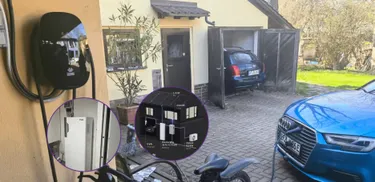
A project example in Berlin shows how this type of system can work in practice. In a residential building, a home battery and wallbox from Ultimati Energie were used and connected to the home energy system. The setup combines an 11.4 kWh home battery, EV charging, and intelligent energy management to make solar electricity more flexible for household use and electric vehicle charging.
EV Charging with Battery Storage vs. No Battery Storage: Quick Comparison
| Factor | Without Battery Storage | With Battery Storage |
|---|---|---|
| Upfront cost | Lower | Higher |
| System complexity | Simpler | More complex, but more flexible |
| Best suited for | Daytime charging, home office, flexible charging | Evening charging, high consumption, greater energy independence |
| Solar self-consumption | Increases when the EV charges during sunny hours | Can increase even outside sunny hours |
| Grid dependence | Remains higher if charging happens at night | Can be reduced with proper system design |
| Flexibility | Depends strongly on sunlight and vehicle availability | Better use of solar power throughout the day |
| Future expansion | Good for basic solar EV charging | Better for EVs, heat pumps, smart home systems, and rising electricity demand |
The decision is not only about battery cost. It is about whether the system fits the household’s daily energy pattern: when solar power is produced, when the EV is charged, and how much electricity is used in the evening.
Long term, the better choice depends on how well the system matches the household’s energy pattern. A smart EV charger may be enough when solar generation and charging time overlap, while battery storage becomes more valuable when solar power needs to be shifted from daytime to evening.
The Role of an Energy Management System
For solar EV charging, hardware alone does not determine performance. The system also needs to coordinate solar production, household consumption, battery state of charge, and EV charging demand.
An energy management system helps decide where solar electricity should go at any given time. Depending on the situation, it can:
supply household loads first
charge the home battery with excess solar power
charge the EV using solar surplus
adjust EV charger output dynamically
reduce unnecessary grid electricity use
provide stored solar power in the evening
Without this coordination, the system may still work technically, but it may not operate efficiently. This is especially important when solar panels, battery storage, and EV charging are combined in one residential energy system.
Long term, what matters is not only battery size, but how well the EV charger, home battery, solar PV system, and energy management system work together.
How Large Should the Battery Be for EV Charging?
A home battery should not be sized simply to fully charge an electric vehicle. In most cases, an EV battery is much larger than a typical residential battery storage system. The better approach is to look at how much solar surplus is available, when the EV is usually charged, and how much electricity the household uses in the evening.
A larger battery may be useful when solar electricity is regularly exported during the day and demand rises later. If the solar PV system produces little surplus, however, extra battery capacity may bring limited benefit.
For accurate sizing, factors such as depth of discharge, charging efficiency, EV charger power, grid connection, and future expansion should also be considered. For a more detailed guide, read: How to Size a Residential Energy Storage System for EV Charging in Europe.
Battery capacity, solar generation, EV charging behavior, and household consumption should always be considered together.
Conclusion: Is Battery Storage Necessary for Solar EV Charging?
Battery storage is not always necessary for solar EV charging. If the electric vehicle can be charged during sunny hours, a smart EV charger may be enough to use solar surplus effectively. Skipping battery storage is not necessarily a mistake, just as adding battery storage is not automatically the best choice.
Battery storage becomes more valuable when solar power needs to be used later in the day, such as for evening EV charging, heat pumps, or homes with higher electricity demand. In that case, a home battery can improve flexibility, increase self-consumption, and reduce grid dependence.
The best solution is not simply the biggest battery. It is a well-matched system that brings together solar panels, a smart EV charger, home battery storage, and intelligent energy management.
For installers, EPC partners, and project planners, Ultimati Energie supports scalable home battery and EV charging solutions for modern residential energy projects. Talk with our team to discuss suitable components for solar storage and EV charging applications.

Ultimati Energie Deutschland GmbH is a Germany-based B2B energy storage system provider specializing in scalable residential and C&I battery storage solutions for European partners.
Become a Partner
Sales: +49 1624886367
Customer Support:
+49 15226994869
Address: Ober der Röth 4, 65824 Schwalbach am Taunus, Germany
Copyright © 2026 Ultimati Energie Deutschland GmbH All rights reserved.