

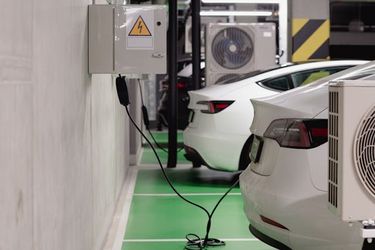
 for EV Charging.jpg)
How to Size a Residential Energy Storage System (ESS) for EV Charging in Europe
Why Energy Storage Systems Are Essential for Residential EV Charging
With electric vehicles (EVs) rapidly becoming the default choice across Europe, demand is growing for cost-effective, future-ready residential charging solutions. Public infrastructure expansion cannot keep pace, especially in dense urban areas and multi-unit dwellings.
For developers, electrical contractors, and energy consultants, integrating an efficient residential energy storage system (ESS) into EV charging projects is now a strategic necessity. Not only does this ensure energy availability and reduce grid dependency, but it also optimizes charging costs—particularly when combined with solar photovoltaic (PV) systems.
Ultimati Energie supports professionals across Europe with scalable, high-efficiency RESS and EV charging solutions tailored to both single-family homes and multi-residential projects.
Understanding Residential EV Charging Demand Across Europe
Single-Family vs. Multi-Family Settings
In a single-family home, charging needs are straightforward: one EV, daily usage of 30–50 km, consuming approximately 3–4 km per kWh. This equates to 7.5–16.7 kWh per day, depending on driving style and terrain. With ~15% energy loss in AC charging, the actual energy drawn from the ESS rises to roughly 9–19.2 kWh per day.
In multi-family homes, the complexity increases. For a property housing 5-10+ EVs, and assuming similar daily driving, cumulative energy demand can exceed 100–150 kWh per day. These projects benefit from shared ESS and load-managed EV charging stations.
Daily and Weekly Charging Patterns
Daily: A single EV commuting 30-50 km consumes ~7.5-16.7 kWh/day (e.g., Renault Zoe: ~10 kWh for 40 km).
Weekly: This accumulates to ~50-117 kWh/week per vehicle, varying by EV model and usage. Understanding these patterns helps you recommend appropriately sized ESS and chargers for your customers, avoiding over- or under-investment.
Key Factors Influencing ESS Sizing for EV Charging
EV Battery Capacity
Common European EVs include Renault Zoe (52 kWh), VW ID.3 (58 kWh), Tesla Model Y (75 kWh), and Skoda Enyaq (77 kWh). Most users charge from 20-80% to preserve battery life, using ~60% of nominal capacity.
Depth of Discharge (DoD)
DoD refers to the percentage of the battery that can be used relative to its total capacity. For instance, a battery with a 90% DoD allows 90% of its total capacity to be utilized. Selecting batteries with higher DoD can provide more usable energy, optimizing the ESS's effectiveness. For a 15 kWh battery with 95% DoD, ~14.25 kWh is usable.
Charging Efficiency
Losses from heat/system inefficiencies reduce efficiency to 85-95%. A 10 kWh EV charge requires ~11.8 kWh from the ESS at 85% efficiency.
Charger Compatibility
European homes use 7.4 kW single-phase chargers (urban settings) or 11-22 kW three-phase chargers (multi-family/rural).
Solar Integration
In high-sun regions (e.g., Spain, Italy, 4-5 kWh/m²/day), pairing ESS with 5-10 kWp solar systems enhances energy independence.
Electrical Infrastructure
Homes need 30-50A, 230/400V circuits for ESS and chargers. As an installer, you must verify panel capacity.
Usable Capacity Formula
Use the following to estimate ESS size:
ESS Size (kWh) = Daily EV Energy Demand ÷ (DoD × Charging Efficiency)
Example:
Single-Family Home (VW ID.3, 40 km/day):
- Consumption: 40 km ÷ 3.5 km/kWh = 11.4 kWh.
- With 85% efficiency: 11.4 ÷ 0.85 = 13.4 kWh.
- At 95% DoD: 13.4 ÷ 0.95 = ~14.1 kWh ESS.
Recommendation: 15 kWh ESS + 7.4 kW charger (charges in ~2 hours).
Multi-Family Residence (8 EVs, 80 kWh/day):
- Consumption: 8 × 10 kWh = 80 kWh.
- With 85% efficiency: 80 ÷ 0.85 = 94.1 kWh.
- At 95% DoD: 94.1 ÷ 0.95 = ~99 kWh ESS.
Recommendation: 100 kWh ESS (stacked units) + 22 kW smart chargers with load balancing.
Solar + ESS (Single-Family, 40 km/day + 10 kWh home use):
- Total: 11.4 kWh (EV) + 10 kWh (home) = 21.4 kWh.
- With 85% efficiency, 95% DoD: 21.4 ÷ (0.85 × 0.95) = ~26.5 kWh.
Recommendation: 30 kWh ESS + 5-8 kWp solar array.
Matching ESS Sizes to Real-World Residential Use Cases
Use Case | Daily EV Need | Suggested ESS | Charger Type | Solar Integration |
Single-Family Home | 10–15 kWh | 12–15 kWh | 7.4 kW single-phase | Yes |
Multi-Family (8 EVs) | 80–120 kWh | 100–120 kWh | 11–22 kW three-phase | Yes |
Off-Peak Grid Charging | 15–20 kWh | 20 kWh | 7.4 kW / 11 kW | No |
European Market-Specific Considerations
High-Cost Electricity Markets
In Germany, Denmark, and Belgium, peak electricity prices can exceed €0.45/kWh, while off-peak tariffs may drop to €0.20/kWh. A 15 kWh ESS storing off-peak energy can save up to €3–5 per charge—amounting to €800–€1,200 in annual savings per EV.
Low-Cost Countries:
In Poland, and Hungary, at €0.15-0.20/kWh, smaller 10-15 kWh ESS suits commuters, offering cost-effective backup.
Solar-Heavy Regions
In Spain, Italy, and southern France, combining ESS with solar PV (5–10 kWp) can result in near-zero EV charging costs for 9–10 months annually. Northern Europe (Norway, Sweden) uses ESS for grid backup.
Government Subsidies
- France: MaPrimeRénov’ – €3,000 to €8,000 for ESS + solar
- Netherlands: ISDE – €2,800 for solar + storage projects
- Germany: KfW programs supporting battery storage and PV integration
Each of these programs lowers payback periods for residential storage from 7–10 years to 4–6 years when bundled with solar.
Ultimati Energie’s Solutions for You
We at Ultimati Energie offer cutting-edge energy storage systems (ESS) and EV chargers designed specifically for Europe’s residential needs, helping you deliver top-tier solutions to your customers:
- Modular ESS: Our scalable RESS units boast a 95% Depth of Discharge (DoD), delivering up to 28.5 kWh of usable capacity from a 30 kWh unit. You can customize these to fit any home, from single-family to multi-family residences.
- High-Efficiency Chargers: Choose our 7.4 kW single-phase chargers for urban homes or our 11-22 kW three-phase chargers for multi-family or rural settings. With smart load management, you ensure efficient charging even in high-demand scenarios.
- Solar Compatibility: Our RESS systems integrate seamlessly with 5-20 kWp solar arrays, maximizing savings for your customers in sunny Southern Europe, like Spain or Italy.
- EU Compliance: We meet EN 50549 grid standards, so you can install our products with confidence, knowing they’re reliable and compliant across Europe.
Practical Tips for You
To help your customers charge their EVs efficiently, we recommend these steps:
- 1. Assess Their Needs: Gather data on their EV models (e.g., Renault Zoe, VW ID.3), daily mileage, and housing type (single-family or apartment complex) to tailor your recommendations.
- 2. Use Our Sizing Formula: Calculate the right ESS size with ESS Size = Daily Consumption / (DoD × Efficiency). For example, a 40 km commute (11.8 kWh) at 95% DoD and 85% efficiency needs ~14.1 kWh—perfect for our 15 kWh ESS.
- 3. Check Electrical Infrastructure: Ensure homes have 30-50A, 230/400V circuits to support our ESS and chargers. Partner with electricians to handle any upgrades.
- 4. Leverage Subsidies: Guide your customers to local incentives, like France’s MaPrimeRénov’ (€3,000-8,000 for ESS), Germany’s KfW, or Netherlands’ ISDE (€2,800 for solar+storage), to reduce costs.
- 5. Promote Solar: In Southern Europe, pair our ESS with 5-10 kWp solar systems for near-zero-cost charging. In Northern Europe, recommend grid-tied ESS for backup power.
Conclusion: Empowering Europe’s Sustainable Future Together
We know you want to provide your customers with efficient, cost-effective, and sustainable EV charging solutions. By considering their EV energy needs, Depth of Discharge, charging efficiency, and regional factors like electricity costs (€0.15-0.45/kWh) and subsidies, you can deliver perfectly sized systems. With Ultimati Energie’s modular ESS and high-efficiency chargers (7.4-22 kW), we give you the flexibility and reliability to meet Europe’s diverse needs while complying with EU standards. Visit https://en.u-energie.de/ to explore product specs, or schedule a consultation. Let’s work together to lead Europe’s EV revolution!

Ultimati Energie Deutschland GmbH is a Germany-based B2B energy storage system provider specializing in scalable residential and C&I battery storage solutions for European partners.
Become a Partner
Sales: +49 1624886367
Customer Support:
+49 15226994869
Address: Ober der Röth 4, 65824 Schwalbach am Taunus, Germany
Copyright © 2026 Ultimati Energie Deutschland GmbH All rights reserved.