

How Deeply Can a Solar Battery Be Discharged?
Photovoltaic systems with battery storage are key to a sustainable energy future. But how deeply can a solar battery be discharged without affecting its lifespan? The Depth of Discharge (DoD) plays a critical role. In this article, we explain what DoD means, how it impacts your solar battery’s lifespan, and how you can optimize your photovoltaic storage in Europe. At Ultimati Energie, we provide advanced solutions to maximize your PV storage efficiency.
What Is the Depth of Discharge (DoD) of a Solar Battery?
The Depth of Discharge (DoD) refers to the percentage of a battery’s total capacity that is used during one charge cycle. For example, if a 10 kWh battery discharges 6 kWh, the DoD is 60%.
- Low DoD (e.g., 20–50%): Gentler on the battery, extends the solar battery lifespan.
- High DoD (e.g., 80–100%): Maximizes usable capacity but shortens lifespan.
Finding the right DoD is essential to balancing available energy and battery durability.
How Does Depth of Discharge Affect Your Solar Battery’s Lifespan?
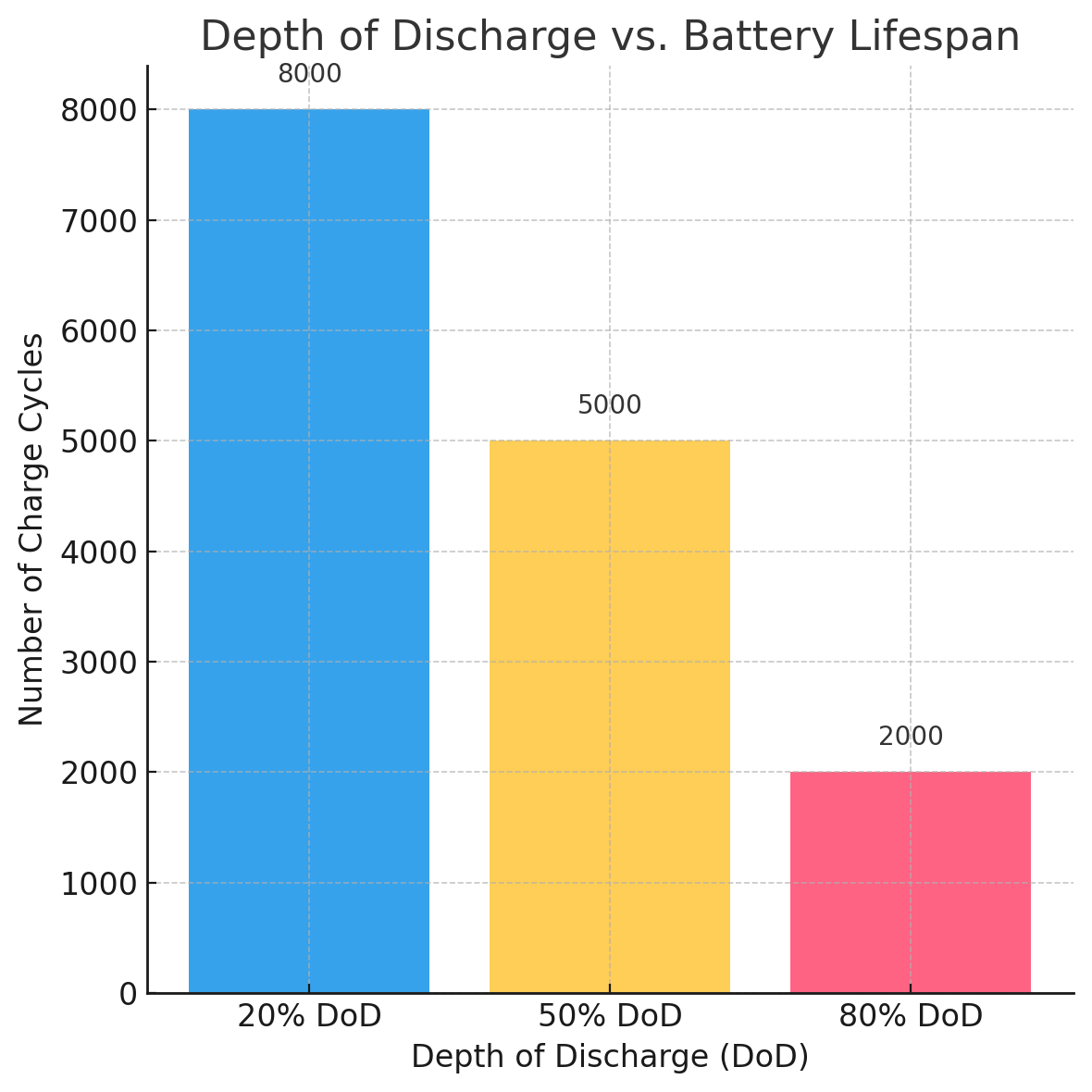
A solar battery’s lifespan is measured in charge cycles—the number of times it can be charged and discharged before its capacity drops to 80% of its original value. Different battery types respond differently to DoD:
Lithium Iron Phosphate Batteries (LiFePO4):
- At 50% DoD: Up to 7,000 cycles (at 15–25°C).
- At 80–90% DoD: 2,000–5,000 cycles.
Lead-Acid Batteries:
- At 50% DoD: 500–1,000 cycles.
- At 80% DoD: Only 200–400 cycles.
For example, a LiFePO4 battery at 50% DoD lasts twice as long as at 80% DoD, saving costs on battery replacements. Our experts at Ultimati Energie help you select the right battery and optimize DoD settings.
How Can You Optimize Depth of Discharge?
To maximize your solar battery lifespan, follow these practical steps:
- Adjust DoD in the Battery Management System (BMS): Open your PV system’s software, navigate to “Settings,” and set the DoD to 50% for household use or 80% for emergencies (e.g., power outages). This optimizes your battery storage.
- Choose High-Quality Batteries: LiFePO4 batteries handle high DoD (up to 90%) better and offer longer lifespans than lead-acid batteries.
- Control Temperature: Install the battery in a space with 15–25°C to avoid damage from extreme heat or cold.
- Prefer Slow Charging: Avoid frequent fast charging, as it stresses the battery chemistry.
- Use Smart Energy Management: Modern photovoltaic storage systems automatically adjust DoD based on your energy consumption.
- Regular Maintenance: Check the BMS annually to ensure optimal DoD settings.
Practical Tips for Different Scenarios
The optimal DoD depends on your usage scenario:
- Household Use: Limit DoD to 40–50% to maximize lifespan. For example, a 10 kWh battery discharging 4 kWh daily remains efficient at 40% DoD for years.
- Off-Grid Systems: A DoD of 80% may be necessary to ensure power supply, though it reduces lifespan.
- Maintenance: Check the BMS yearly to confirm correct DoD settings.
Economic and Environmental Benefits
Optimizing your solar battery depth of discharge offers dual benefits:
- Cost Savings: Fewer battery replacements due to extended lifespan.
- Sustainability: Reduced battery waste protects the environment.
- Efficiency: Higher self-consumption of solar energy lowers your electricity bills.
With the right settings, you can maximize the lifespan of your photovoltaic storage in Europe. Let Ultimati Energie help you reduce energy costs!
Frequently Asked Questions (FAQ)
How do I set the DoD as a beginner?
Use your PV system’s manual or let Ultimati Energie assist you in configuring the DoD via the BMS.
Which battery is best for my PV storage?
LiFePO4 batteries offer the best balance of lifespan and DoD tolerance.
How does fast charging affect the battery?
Frequent fast charging can stress the battery chemistry and shorten its lifespan.
How does deep discharge impact the battery?
Complete discharge to 0% can cause permanent damage, especially in lead-acid batteries. LiFePO4 batteries have protective mechanisms, but deep discharge still reduces lifespan. A well-configured BMS prevents this.
How do I set the optimal DoD for backup power?
For backup power, a higher DoD (e.g., 80%) ensures sufficient energy. Configure this via your BMS or app, ideally at 50% for daily use and 80% for emergencies. Ultimati Energie can guide you in optimizing your battery storage.
Conclusion: Maximize Your Solar Battery with Ultimati Energie
The depth of discharge is the key to a long-lasting and efficient photovoltaic storage system. By setting the right DoD, choosing high-quality batteries, and using smart systems, you can save costs and protect the environment. At Ultimati Energie, we offer advanced solutions for your battery storage in Europe.
Contact us today for a storage analysis customized for your photovoltaic storage. Together, we’ll optimize your solar battery’s lifespan and reduce your energy costs sustainably.

Ultimati Energie Deutschland GmbH is a Germany-based B2B energy storage system provider specializing in scalable residential and C&I battery storage solutions for European partners.
Become a Partner
Sales: +49 1624886367
Customer Support:
+49 15226994869
Address: Ober der Röth 4, 65824 Schwalbach am Taunus, Germany
Copyright © 2026 Ultimati Energie Deutschland GmbH All rights reserved.