

The Dutch Home Battery Market Is Maturing. Here's What It Means for Residential Energy Storage in 2026
The Netherlands has long been one of Europe's leading residential solar markets. As rooftop PV adoption continues to grow, home battery systems are becoming an increasingly important part of household energy management.
However, the Dutch residential energy storage market is no longer defined simply by installation growth. It is entering a more mature stage, where the focus is gradually shifting from whether homeowners should install a battery to how to maximize the long-term value of residential energy storage.
Instead of comparing battery capacity alone, homeowners are paying closer attention to energy management capabilities, dynamic electricity tariffs, long-term return on investment (ROI), system reliability, and after-sales support. For installers, this means delivering complete energy solutions rather than simply supplying battery hardware.
This evolution reflects a broader shift across the residential energy sector. As battery adoption becomes more widespread, purchasing decisions are increasingly based on long-term system performance, intelligent energy management, and the ability to adapt to changing household energy needs. For manufacturers and installers alike, success is no longer measured simply by the number of systems deployed, but by the long-term value those systems deliver.
For installers, distributors, and residential energy solution providers, this evolution presents new opportunities. As customer expectations continue to rise, competitive advantage is increasingly determined by system intelligence, installation quality, software capabilities, and long-term service—not simply by battery specifications.
Dutch Home Battery Market at a Glance
| Market Trend | What It Means for the Industry |
| Home battery adoption continues to increase | Residential battery storage is becoming a mainstream component of home energy systems. |
| Customer priorities are changing | Purchasing decisions increasingly focus on long-term value rather than battery capacity alone. |
| Energy management is becoming more important | Software, intelligent scheduling, and system optimization are becoming key differentiators. |
| The installer's role is evolving | Customers expect professional advice, long-term support, and complete residential energy solutions. |
Why Homeowners Are Looking Beyond Battery Capacity
As the Dutch home battery market matures, purchasing decisions are becoming more sophisticated. A few years ago, homeowners primarily compared battery capacity and upfront cost. Today, those factors remain important, but they are no longer the only criteria influencing purchasing decisions.
Instead, homeowners are increasingly evaluating how a battery system performs as part of a complete home energy ecosystem. The ability to optimize solar self-consumption, respond to dynamic electricity tariffs, provide backup power, and intelligently manage household energy usage is becoming a key differentiator.
This shift is also changing the role of residential installers. Rather than simply recommending a battery based on capacity, installers are expected to help homeowners choose a system that matches their energy consumption patterns, future electricity demand, and long-term financial goals.
What Homeowners Are Prioritizing Today
| Then | Now |
| How many kilowatt-hours do I need? | How much can I reduce my electricity costs over time? |
| Which battery is the cheapest? | Which system offers the best long-term value? |
| Will it work with my solar panels? | Can it intelligently manage my home's energy consumption? |
| How long is the warranty? | Who will support the system after installation? |
Smart Energy Management System Is Becoming the Real Differentiator
When the Dutch residential battery market was still in its early stages, most purchasing decisions were straightforward: compare battery capacity, compare price, and choose a system that could store excess solar energy.
Today, that conversation has changed.
As more Dutch households adopt dynamic electricity tariffs, electric vehicles, heat pumps, and smart home technologies, simply storing electricity is no longer enough. Homeowners increasingly expect their battery system to make intelligent decisions throughout the day—charging when electricity is inexpensive, supplying power when household demand increases, and maximizing the value of every kilowatt-hour generated by their rooftop PV system.
This shift is changing what customers expect from residential energy storage.
How Customer Expectations Are Changing
| A Few Years Ago | Today |
| How many kWh do I need? | How can I reduce my electricity bill every day? |
| Which battery is the cheapest? | Which system manages energy most intelligently? |
| Can it store my solar power? | Can it coordinate PV, EV charging, heat pumps and household loads? |
| Battery hardware was the priority. | Software, EMS and long-term service are equally important. |
For installers, this means that battery specifications are no longer the only selling point. Customers are increasingly asking how a complete energy storage system will perform over the next ten or fifteen years rather than simply comparing hardware.
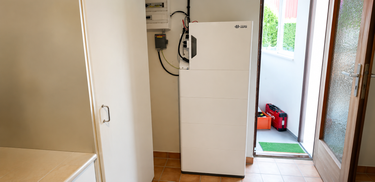
One example is Ultimati Energie's RE-HA1 High-Voltage All-in-One Residential Energy Storage Solution. Powered by the UltiCloud Energy Management System, the platform continuously analyzes household electricity demand, PV generation and battery status to optimize charging and discharging automatically. Instead of relying on fixed schedules, homeowners benefit from an intelligent system that adapts to changing energy conditions in real time.
The same shift is also changing the installation process. As residential projects become more sophisticated, installers are looking for systems that reduce commissioning time while simplifying long-term maintenance.
Beyond the Battery: What Installers Value
- Faster installation and commissioning
- Intelligent Energy Management (EMS)
- Remote monitoring and OTA software updates
- Easy integration with EV chargers and heat pumps
- Reliable after-sales support
- Simplified troubleshooting
To support these requirements, the RE-HA1 All-in-One architecture integrates the inverter, battery modules and control system into a single compact platform, reducing on-site wiring and making installation more efficient. Through UltiCloud, installers can remotely monitor system performance, diagnose issues and update software without visiting the site.
Commissioning is another area where small improvements can make a significant difference. Incorrect CT orientation or phase wiring can often delay installation and require additional troubleshooting.
To simplify this process, Ultimati Energie's Smart Meter automatically detects phase sequence and CT wiring errors and supports one-click calibration through the UltiCloud App. This helps installers complete commissioning more efficiently while ensuring accurate energy monitoring from the first day of operation.
A residential battery is no longer just an energy storage device. It is becoming the intelligent control center of the modern home.
As the Dutch market continues to mature, the competitive advantage is shifting from battery capacity alone to complete residential energy management. For installers, delivering long-term value increasingly means choosing solutions that combine intelligent software, flexible system integration and simplified installation—not simply larger batteries.
Ultimati Energie Deutschland GmbH is a Germany-based B2B energy storage system provider specializing in scalable residential and C&I battery storage solutions for European partners.
Become a Partner
Sales: +49 1624886367
Customer Support:
+49 15226994869
Address: Ober der Röth 4, 65824 Schwalbach am Taunus, Germany
Copyright © 2026 Ultimati Energie Deutschland GmbH All rights reserved.