

Commercial Energy Storage in Germany: 6 Revenue Streams That Drive ROI
In many commercial and industrial (C&I) energy storage projects in Germany, financial evaluation often starts with a single use case: charging electricity at low prices and discharging when prices are high.
This remains relevant in Germany, particularly with dynamic pricing linked to the European Power Exchange. However, this approach only captures part of the value.
As a result: relying on arbitrage alone can extend payback from ~5 years to 8–10 years.
But this doesn’t mean energy storage is less viable. It means: you are only capturing 1 out of multiple C&I energy storage revenue streams.
What Are C&I Energy Storage Revenue Streams?
C&I energy storage revenue streams refer to the multiple value sources that battery systems can generate in commercial and industrial applications.
In Germany, the main revenue streams include:
- Electricity price arbitrage
- PV self-consumption optimization
- Peak demand charge reduction (Leistungspreis)
- Demand response and grid incentives
- Electricity spot market trading
- Ancillary services (FCR and aFRR)
Rather than relying on a single use case, most projects achieve strong returns through revenue stacking, combining multiple value streams.
The 6 Revenue Streams for C&I Energy Storage in Germany
| Revenue Stream | Applicability | Stability | ROI Potential |
|---|---|---|---|
| Price Arbitrage (Spot / Dynamic Tariff) | All users | Medium | Medium |
| PV Self-Consumption Optimization | Sites with solar | High | High |
| Peak Shaving (Leistungspreis) | Medium/large users | Very High | Very High |
| Demand Response & Grid Incentives | Flexible loads | Medium | Medium |
| Electricity Spot Market Trading | Large consumers / aggregators | Medium | High |
| Ancillary Services (FCR, aFRR) | Aggregated systems | Medium | High |
1. Electricity Price Arbitrage in Germany (Dynamic Pricing)
Electricity price arbitrage remains one of the most common commercial energy storage revenue streams in Germany.
In Germany, prices are determined by wholesale markets rather than fixed tariffs. Through platforms such as the European Power Exchange, electricity prices fluctuate on an hourly (day-ahead) or 15-minute (intraday) basis.
How it works
- Charge the battery during low-price periods (high renewable generation)
- Discharge during high-price periods (peak demand or low renewable supply)
Typical price spread (Germany)
- Low price: €0.05–0.10/kWh
- High price: €0.25–0.40/kWh
- Effective spread: €0.15–0.25/kWh
Example
A 500 kWh system with one full cycle per day:
- Usable energy (after losses): ~450 kWh
- Average spread: €0.20/kWh
- Daily revenue: ~€90
- Annual revenue: ~€30,000–35,000
Key considerations
- Price spreads vary by season and market conditions
- Requires forecasting or automated optimization
- Not all days provide ideal arbitrage opportunities
In Germany, arbitrage is market-driven and flexible, but not a standalone business case.
2. PV Self-Consumption Optimization with Battery Storage (Energy Shifting)
For sites with on-site solar generation, PV self-consumption optimization is one of the most stable C&I energy storage revenue streams.
The structural mismatch
- Solar generation peaks at midday
- Industrial demand often peaks later in the day
- Excess energy is exported at low compensation
Feed-in tariffs (EEG): €0.06–0.10/kWh
Retail electricity price: €0.25–0.35/kWh
Storage value
Energy storage enables:
- storing excess solar generation
- using it later when electricity prices are higher
Economic impact
Each kWh shifted from export to self-consumption can generate: €0.15–0.25/kWh additional value
Example
A manufacturing site with PV:
- Self-consumption increases from 60% → 85%
- Reduced grid purchases during peak hours
- Improved ROI of both PV and storage assets
Given the significant gap between feed-in tariffs and retail electricity prices in Germany, PV self-consumption optimization is often one of the most stable and highest-value C&I energy storage revenue streams.
For many commercial projects in Germany, optimizing self-consumption is often the first step toward achieving a strong return on investment.
→ Explore how integrated energy storage systems can support this strategy.
3. Peak Shaving (Leistungspreis Reduction in Germany)
Peak shaving is one of the most important commercial energy storage revenue streams in Germany, especially for high-load industrial users.
Large electricity consumers are subject to capacity-based grid charges (Leistungspreis).
These charges are based on: the maximum power demand (kW) during a billing period
Typical cost level: €70–120 per kW per year
The challenge: Short-duration power spikes can significantly increase annual costs.
Example
- Normal operation: 800 kW
- Peak spike: 1,200 kW
- Excess demand: 400 kW
Annual cost:
400 × €100 = €40,000/year
Storage solution
- Battery discharges during peak events
- Reduces grid import at critical moments
- Limits peak demand
Benefits
- Highly predictable savings
- Independent of electricity price volatility
- Immediate financial impact
It is often the most reliable ROI driver in C&I energy storage systems.
4. Demand Response & Grid Incentives in Germany
Demand response programs represent an additional commercial energy storage revenue stream in Germany, supported by regulatory frameworks such as §14a EnWG and Redispatch 2.0.
Concept
Grid operators request:
- load reduction during peak stress
- load increase during surplus generation
Role of energy storage
- Respond instantly without disrupting operations
- Shift consumption profiles in real time
Revenue structure
- Direct payments for flexibility (€/kWh)
- Reduced grid fees under specific programs
Typical annual value:
€5,000–15,000/year for mid-scale systems(depending on participation frequency and contract terms)
Limitations
While not dominant alone, it contributes to incremental revenue stacking.
5. Electricity Spot Market Trading with BESS
Electricity spot market trading is an advanced commercial energy storage revenue stream that extends beyond traditional arbitrage.
Germany’s spot market enables:
- day-ahead trading
- intraday trading (15-minute resolution)
Market characteristics
- High volatility
- Occasional negative pricing
- Multiple trading cycles per day
Storage Strategy
- Charge during low or negative prices
- Discharge during high-price intervals
- Execute multiple cycles if economically viable
Example
- Low price: €0.00–0.05/kWh
- High price: €0.35–0.45/kWh
This allows:
- higher frequency trading compared to simple arbitrage
- improved utilization of storage assets
Requirements
- market access
- forecasting algorithms
- trading automation
This is a more advanced extension of arbitrage, with higher potential but greater complexity.
6. Ancillary Services (FCR / aFRR) for Battery Storage
Ancillary services such as FCR and aFRR represent high-value C&I energy storage revenue streams in Germany’s balancing markets.
Key system operators include:
- TenneT
- 50Hertz
Relevant services for storage
- Frequency Containment Reserve (FCR)
- Automatic Frequency Restoration Reserve (aFRR)
Why storage fits
- Fast response (milliseconds)
- High accuracy
- High availability
Revenue model
- Capacity-based payments (€/MW/h)
Typical annual revenue: €20,000–60,000 per MWh (market-dependent)
Constraints
- Minimum bid size (often ≥1 MW)
- Requires aggregation via virtual power plant (VPP)
High-value but technically and commercially demanding revenue stream.
Real-World Case: High-Power EV Truck Charging Site in Germany
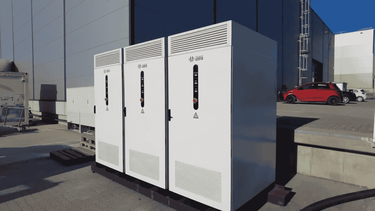
To illustrate how multiple value streams interact in a real deployment, consider a commercial EV charging site in Germany where energy storage is not used for a single purpose, but as a system-level enabler.
Site Overview
- Location: Alheim, Germany (industrial logistics site)
- Application: Electric truck fast charging company
- Fleet: 3 electric trucks (with expansion planned)
- Charging infrastructure: 2 × 400 kW fast chargers
- Renewable generation: 600 kWp rooftop PV system
- Grid connection limit: only 160 kW
At first glance, the site appears structurally constrained: the grid connection is far below the required charging power.
System Configuration
To solve this constraint, the following system was deployed:
- 3 × UltiBlock TL261 systems
- Each unit: 125 kW / 261 kWh
- Total system power: 375 kW
- Total energy capacity: 783 kWh
Core Challenge
Electric trucks typically require:
- 200–350 kW charging power per vehicle
- Very short dwell time (logistics operation constraint)
Without additional flexibility, the site cannot support fast charging operations reliably.
System-Level Energy Logic
The energy system operates as a coordinated architecture:
1. Renewable-first operation
- PV generation is prioritized during daytime
- Directly powers charging when available
2. Battery buffering layer
- 375 kW storage output compensates for grid limitation
- Provides stable high-power output during peak charging demand
3. Grid constraint management
- Grid import strictly capped at 160 kW
- Storage and PV ensure no operational limitation is triggered
Power Availability Analysis
Value Beyond Arbitrage
This project demonstrates that energy storage in Germany is not only an arbitrage tool, but a system enabler for electrification infrastructure.
It simultaneously enables:
- EV fast charging under grid constraints
- PV utilization without curtailment
- Peak load stabilization
- Infrastructure scalability without grid upgrade
Why This Case Matters for the 6 Revenue Model
This project directly combines multiple value streams:
- PV self-consumption optimization
- Peak shaving (grid constraint management)
- Electricity cost reduction through reduced grid dependence
- Indirect arbitrage via energy shifting
But more importantly, it introduces a fourth dimension of value: Energy storage as an infrastructure enabler for EV charging systems.
Which Revenue Stream Matters Most?
Not all revenue streams contribute equally to every project.
- Peak shaving → best for high-demand industrial users
- PV self-consumption → best for solar-integrated sites
- FCR / ancillary services → best for large or aggregated systems
- Spot trading → best for advanced operators with market access
Choosing the right combination is essential for maximizing ROI.
How to Choose the Right Revenue Model
Different projects prioritize different revenue streams:
- With PV → focus on self-consumption
- With high peak load → peak shaving
- With market access → FCR / trading
- With constraints → system-level optimization
The most successful projects combine multiple C&I energy storage revenue streams.
Who Should Consider These Revenue Streams?
These C&I energy storage revenue streams are particularly relevant for:
- Industrial facilities with high peak demand charges
- Commercial buildings with on-site PV systems
- EV charging infrastructure operators
- Logistics and manufacturing sites with constrained grid access
- Energy aggregators and project developers
Projects in these categories can benefit most from revenue stacking strategies.
Risks to Consider
- Market price volatility
- Regulatory changes
- Dependence on aggregators
- System sizing errors
A well-designed system is critical to achieving stable ROI.
Conclusion: From Energy Storage to Revenue System
Commercial energy storage in Germany is no longer just a cost-saving tool.
It is:
- a revenue generator
- a flexibility asset
- a key infrastructure enabler
Projects that rely on a single revenue stream often underperform.
Projects that adopt revenue stacking strategies achieve:
- shorter payback
- higher ROI
- greater system utilization
FAQ: C&I Energy Storage Revenue Streams
What is the most profitable energy storage application in Germany?
Peak shaving and PV self-consumption are typically the most stable and profitable.
How long is the payback period?
Usually 4–8 years, depending on revenue stacking.
Is energy storage profitable in Germany?
Yes, especially when multiple revenue streams are combined effectively.
What is revenue stacking in energy storage?
It refers to combining multiple value streams to maximize system utilization and ROI.
Do all projects require EMS optimization?
In most cases, yes — energy management systems are critical for maximizing performance and revenue.
Can battery storage participate in FCR markets?
Yes, typically via aggregation platforms.
Which C&I energy storage revenue stream provides the highest ROI?
In most cases, peak shaving and PV self-consumption provide the most stable and predictable returns, while ancillary services and trading offer higher but more variable income.
Looking to maximize ROI from your commercial energy storage project in Germany?
Explore how Ultimati Energie supports commercial and industrial energy storage projects — from system selection to deployment strategy — or visit our official website to learn more.
Ultimati Energie Deutschland GmbH is a Germany-based B2B energy storage system provider specializing in scalable residential and C&I battery storage solutions for European partners.
Become a Partner
Sales: +49 1624886367
Customer Support:
+49 15226994869
Address: Ober der Röth 4, 65824 Schwalbach am Taunus, Germany
Copyright © 2026 Ultimati Energie Deutschland GmbH All rights reserved.