

How to Choose the Right C-Rate for Your BESS (0.5C vs 1C vs 2C in Germany)
C-rate in battery storage defines how fast a battery charges or discharges relative to its capacity, determining power output, discharge duration, and revenue potential in commercial BESS.
This is not just a theoretical concept—it directly impacts real-world performance.
Last week, we spoke with a factory owner in southern Germany. He installed a 261 kWh commercial energy storage system, and after a few months, he said:
“The system works fine. But the revenue is lower than expected.”
We asked about the configuration.
“It’s a 1C system. That’s what everyone recommended.”
Then we checked his load profile:
- Morning peak: 09:00–12:00 (3 hours)
- Afternoon peak: 14:00–18:00 (4 hours)
The issue became immediately clear:
The system wasn’t wrong — the C-rate was.
What Does C-Rate Mean in Battery Storage Systems?
C-rate in battery storage defines how fast a battery charges or discharges relative to its capacity. It links energy capacity (kWh) with power output (kW), determining discharge duration and system performance.
In commercial battery energy storage systems (BESS), C-rate is a key parameter for system sizing, power configuration, and revenue optimization—especially in peak shaving and energy arbitrage applications.
C-rate Formula:
C-rate is used to calculate the power output of a battery system:
Power (kW) = Capacity (kWh) × C-rate
This formula is widely used in BESS design and system sizing. It determines how quickly stored energy can be delivered to support peak shaving or energy arbitrage.
Quick reference:
| C-Rate | Discharge Time | Power (for 261 kWh system) |
|---|---|---|
| 0.5C | 2 hours | ~130 kW |
| 1C | 1 hour | 261 kW |
| 2C | 0.5 hour | 522 kW |
Intuitive understanding:
- kWh (capacity) = fuel tank
- kW (power) = engine size
- C-rate = how fast you burn the fuel
How to Choose the Right C-Rate for Your BESS
To select the right C-rate, match your system configuration with your load profile and revenue model:
- Peak duration > 2 hours → choose 0.5C
- Peak duration 1–2 hours → choose 1C
- Short spikes (<1 hour) → choose 2C
If your goal is:
- Energy arbitrage → lower C-rate
- Demand charge reduction → higher C-rate
There is no “best” C-rate—only the one that matches your load profile.
Why C-Rate Impacts Battery Storage Revenue and Peak Shaving
Different C-rates fundamentally change how your storage system earns money:
| C-Rate | Best Use Case | Revenue Logic |
|---|---|---|
| 0.5C | Long peak windows | Full-cycle arbitrage |
| 1C | Standard applications | Balanced |
| 2C | Demand charge reduction | High power bursts |
Scenario Comparison: Same System, Different C-Rate
Option A — 125 kW / 261 kWh (≈0.5C)
- Discharge duration: ~2 hours
- Covers major portion of peak window
Revenue estimation:
| Component | Value |
|---|---|
| Daily cycles | 2 |
| Daily arbitrage | 261 × 2 × €0.20 = €104 (based on typical German electricity price spreads of €0.15–€0.25/kWh) |
| Annual (300 days) | ~€31,200 |
✔ Fully utilizes peak windows
✔ Lower battery stress → longer lifespan
✔ Easier grid approval in Germany
Option B — 261 kW / 261 kWh (1C)
- Discharge duration: 1 hour
- Peak windows not fully covered
Revenue estimation:
| Component | Value |
|---|---|
| Daily cycles | 1–1.5 |
| Daily arbitrage | ~€52–€78 |
| Annual | ~€16,000–€23,000 |
⚠ Energy depleted too quickly
⚠ Remaining peak hours = lost revenue
When Each C-Rate Actually Makes Sense
0.5C C-Rate – Energy Optimization
Best suited for longer discharge durations and stable daily cycling.
- Long peak windows (> 2 hours)
- Energy arbitrage-focused operation
- Consistent daily charge/discharge cycles
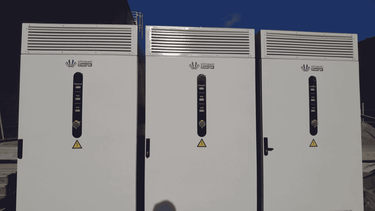
Example: Ultiblock TL261 261 kWh C&I BESS
1C C-Rate – Balanced Performance
A versatile option balancing power and duration.
- Peak duration of ~1–2 hours
- Combination of arbitrage and peak shaving
- General commercial applications
2C C-Rate – High Power Output
Designed for short, high-intensity power demands.
- Demand charge reduction
- Short-duration peak spikes
- Fast-response grid or industrial applications
Important clarification:
If the facility had shorter peak durations or higher demand charges, the 1C system in the original case could actually deliver better performance and higher revenue.
This reflects a fundamental principle in commercial battery energy storage system (BESS) design:
There is no universally “best” C-rate — only the C-rate that aligns with your load profile, peak duration, and revenue strategy.
Battery Lifetime Impact by C-Rate
| C-Rate | Estimated Battery Lifespan |
|---|---|
| 0.5C | ~100% (baseline lifespan) |
| 1C | ~85–90% of baseline |
| 2C | ~70–80% of baseline |
Why Many 1C Systems Underperform in Germany
Because real-world conditions are changing:
1. Peak periods are longer than before
Not 1–2 hours anymore, but often 3–5 hours
2. Arbitrage dominates SME projects
Price spread > €0.15–0.25/kWh → longer discharge preferred
3. Grid constraints favor lower power
Lower kW systems are:
- Easier to approve
- Lower grid impact
Conclusion
The mistake is not choosing a 1C system.
The mistake is choosing a C-rate without aligning it with your load profile.
In today’s German energy market, several trends are reshaping optimal system design:
• Longer peak duration windows
• Strong energy arbitrage opportunities
• Increasing grid constraints and capacity limits
These factors make lower C-rate configurations—such as 0.5C systems (e.g. 125 kW / 261 kWh systems like the Ultiblock TL261)—increasingly relevant.
However, the key principle remains unchanged:
The best C-rate is not universal—it is application-specific.
FAQs About C-Rate in Battery Storage
What is C-rate in battery storage?
C-rate defines how fast a battery charges or discharges relative to its capacity.
How do you calculate battery C-rate?
C-rate is calculated as:
Power (kW) = Capacity (kWh) × C-rate
How to choose the right C-rate for a BESS system?
It depends on peak duration and revenue strategy. Longer peaks require lower C-rates, while short spikes benefit from higher C-rates.
What is the difference between kW and kWh in battery storage?
kWh represents energy capacity, while kW represents power output.

Ultimati Energie Deutschland GmbH is a Germany-based B2B energy storage system provider specializing in scalable residential and C&I battery storage solutions for European partners.
Become a Partner
Sales: +49 1624886367
Customer Support:
+49 15226994869
Address: Ober der Röth 4, 65824 Schwalbach am Taunus, Germany
Copyright © 2026 Ultimati Energie Deutschland GmbH All rights reserved.