

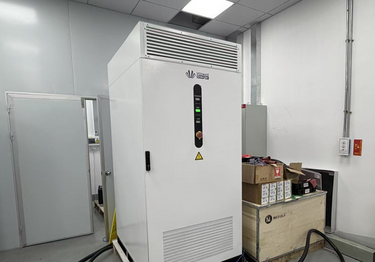
AI Data Center Energy Storage: How Europe’s Grid Constraints Are Driving New Demand
As Europe accelerates AI adoption and renewable energy deployment, AI data centers in Europe are facing a new power challenge: how to secure reliable, flexible energy within increasingly constrained electrical grids.
Unlike traditional data centers, AI-driven facilities require higher power density, faster load response, and more dynamic energy management. The IEA projects that global data center electricity consumption could double by 2030, with AI becoming one of the largest drivers of future power demand.
This makes AI data center energy storage in Europe a critical part of infrastructure planning, especially as the market shifts toward edge AI, regional inference clusters, private enterprise AI infrastructure, and industrial AI facilities.
In this environment, battery storage for AI data centers is no longer just emergency backup. It is becoming a core energy layer for power stability, peak shaving, renewable integration, and long-term operational efficiency.
As a Germany-based B2B energy storage solution provider, Ultimati Energie supports European partners with C&I energy storage solutions, scalable battery storage architecture, and localized project coordination.
Why Europe’s AI Infrastructure Is Different from the US
Europe’s AI infrastructure is developing under different market conditions from the United States. While the US market is strongly driven by large hyperscale campuses, Europe faces a more fragmented energy and regulatory environment.
Several factors are shaping this difference:
European Market Factor | Impact on AIDC Infrastructure |
Grid congestion | Limits large centralized AI campus deployment |
High electricity prices | Pushes operators toward local energy optimization |
Renewable-heavy grids | Require flexible balancing capability |
Data sovereignty regulations | Encourage localized and private AI infrastructure |
Industrial digitalization | Creates demand for edge AI near factories and logistics sites |
Across Europe, grid constraints are already affecting the pace of new energy and industrial projects. More than 1,000 GW of renewable capacity remains delayed in interconnection queues, showing how limited grid infrastructure can slow down large-scale deployment.
For AI infrastructure, this means hyperscale expansion may face higher barriers in some regions, while smaller, distributed, and regionally integrated deployments become more practical. This shift creates strong demand for energy storage for data centers, especially in commercial and industrial environments that require flexible power coordination.
Why AI Data Centers Need More Energy Storage Than Traditional Data Centers
Traditional data centers usually run with relatively predictable power loads. AI data centers are different. Their GPU-intensive workloads can create rapid, synchronized changes in electricity demand, especially during model training, inference peaks, and high-density rack operation.
This makes AI data center power demand harder to manage in three ways:
- Short-duration power spikes caused by GPU load surges
- Higher rack-level power density, which increases local grid and cooling pressure
- Fast workload fluctuations, especially in inference-heavy environments
For European AI data centers, this challenge is even more significant because many sites operate within constrained grids, high electricity price environments, and renewable-heavy power systems.
That is why BESS for data centers is becoming increasingly important. Battery energy storage can provide fast response, stabilize short-duration power fluctuations, support peak shaving, and improve renewable energy utilization for AI infrastructure.
Three Core Energy Storage Functions for AI Data Centers in Europe
1. Millisecond-Level Power Buffering
For edge AI clusters, enterprise AI servers, and industrial AI facilities, fast response capability is essential.
Battery storage can help:
- stabilize GPU power fluctuations
- prevent voltage drops during sudden load surges
- protect sensitive computing equipment
- support dynamic load balancing
- improve local power quality
This function is especially important for edge AI energy storage applications in smart manufacturing, automation centers, logistics hubs, and enterprise-owned inference clusters.
2. C&I Energy Coordination for AI Operations
Many European AI deployments will not be built as standalone hyperscale campuses. Instead, they may be integrated into commercial and industrial sites.
This creates demand for C&I energy storage solutions that can coordinate power generation, grid supply, storage, and AI computing loads.
Requirement | Why It Matters |
Reduce demand charges from AI load spikes | |
PV integration | Maximize on-site renewable utilization |
Flexible dispatch | Balance compute load with energy availability |
Backup resilience | Maintain uptime during grid instability |
EMS coordination | Optimize energy cost and system efficiency |
For these scenarios, battery storage is not just an isolated asset. It becomes part of a coordinated source-grid-load-storage architecture.
3. Multi-Hour Storage for Grid Participation
As AI power demand grows, operators also need to control long-term electricity costs.
Multi-hour battery storage can support:
- electricity price arbitrage
- renewable energy shifting
- peak shaving
- ancillary service participation
- frequency regulation
- local grid congestion mitigation
In Europe, this is especially important because renewable penetration is increasing, electricity prices remain volatile, and grid balancing demand continues to grow.
For AI infrastructure operators, commercial battery storage can therefore serve two roles at the same time: improving power stability and creating a financial optimization layer.
What Type of Energy Storage Is Suitable for AI Data Centers?
Different AI deployments require different storage architectures. The optimal solution depends on workload intensity, grid conditions, uptime requirements, and whether the facility prioritizes backup resilience, cost optimization, or renewable integration.
| Storage Type | Typical Role | Suitable AI Scenario |
|---|---|---|
| UPS systems | Short-term emergency backup | Traditional data centers requiring uninterrupted power during outages |
| Lithium battery storage | Fast response, peak shaving, load stabilization | AI workloads with rapid GPU power fluctuations |
| C&I BESS | Energy optimization and flexible dispatch | Enterprise AI infrastructure and industrial AI facilities |
| Hybrid UPS + BESS | Backup resilience + operational optimization | AI sites needing both uptime protection and energy cost control |
| Multi-hour battery storage | Energy shifting, arbitrage, ancillary services | Distributed AI facilities exposed to electricity price volatility |
For many European deployments, the most effective approach may not be a single storage product. Instead, integrated architectures combining UPS protection, lithium battery storage, EMS coordination, and flexible C&I deployment can provide greater long-term resilience and cost efficiency.
How Ultimati Energie Supports European AI Energy Projects
AI infrastructure projects in Europe require more than standardized battery hardware. They need energy partners that understand local grid constraints, C&I deployment requirements, and European project coordination.
As a Germany-based B2B energy storage solution provider, Ultimati Energie supports European partners through localized project communication, flexible C&I energy storage integration, and scalable battery storage architecture for distributed AI infrastructure.
Local European Project Coordination
Ultimati Energie provides local communication, European project support, and faster coordination for EPC partners, installers, energy developers, and commercial operators. This helps project teams respond more efficiently to site-specific requirements, grid conditions, and deployment timelines.
Flexible C&I Energy Storage Integration
AI infrastructure projects often require non-standard sizing, modular expansion, and fast deployment. Ultimati Energie’s C&I-oriented structure supports flexible battery energy storage system integration for distributed commercial and industrial applications.
Scalable Battery Storage Architecture
From edge AI facilities to regional inference clusters, many European AI projects need scalable energy systems. Ultimati Energie supports storage architectures designed for peak shaving, renewable integration, backup resilience, EMS coordination, and long-term energy optimization.
Long-Term Partnership Model
Ultimati Energie works with EPC partners, energy developers, installers, aggregators, and commercial operators to build localized energy ecosystems across Europe.
This makes Ultimati Energie well-positioned to support the next stage of AI data center energy storage and distributed AI energy infrastructure development in Europe.
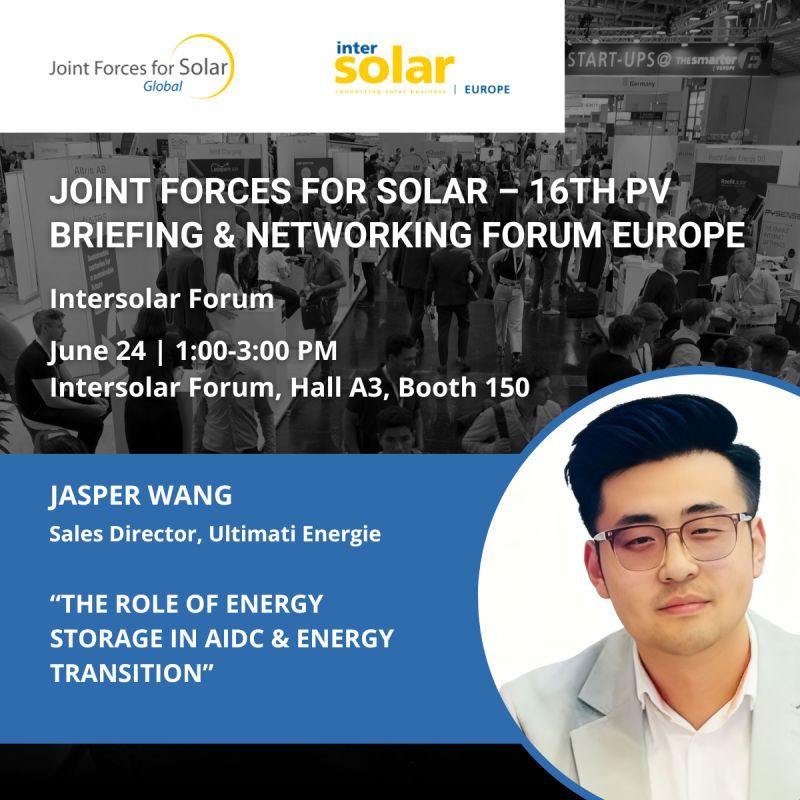
Intersolar Europe 2026: Discussing the Future of AIDC Energy Infrastructure
At Intersolar Europe 2026, Ultimati Energie will discuss how energy storage is evolving from backup infrastructure into a core enabler of Europe’s AI energy architecture.
Session Information
- Date: June 24, 2026
- Time: 14:20–14:30
- Location: Hall A3, Booth A3.150 — Joint Forces for Solar Forum
- Speaker: Jasper Wang
- Topic: The Role of Energy Storage in AIDC & Energy Transition
Key discussion themes include:
- Why AI-driven data centers are becoming a new structural storage demand driver
- How Europe’s grid constraints are reshaping AI infrastructure deployment
- The growing importance of distributed C&I energy storage for edge AI and enterprise AI facilities
- Why localized energy integration capability matters more than standardized hardware alone
- How storage bridges the gap between AI growth and renewable-heavy power systems
Conclusion: Europe's AI Future Depends on Energy Architecture
Europe's AI infrastructure will not be built only through larger data centers. It will also depend on distributed AI facilities, localized compute, renewable integration, and intelligent energy coordination.
This creates a new opportunity for energy storage providers that can support flexible integration, C&I-scale deployment, localized project coordination, and scalable battery storage architecture.
As AI and energy systems converge, AI data center energy storage will become a key part of Europe's next-generation infrastructure.
For Europe, the future of AI is not only about compute power. It is also about how that compute power is supplied, stabilized, optimized, and integrated into the energy system.
Ultimati Energie Deutschland GmbH is a Germany-based B2B energy storage system provider specializing in scalable residential and C&I battery storage solutions for European partners.
Become a Partner
Sales: +49 1624886367
Customer Support:
+49 15226994869
Address: Ober der Röth 4, 65824 Schwalbach am Taunus, Germany
Copyright © 2026 Ultimati Energie Deutschland GmbH All rights reserved.