

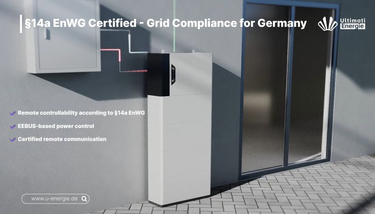
Germany’s energy transition is progressing rapidly, and with it the demands for grid integration, controllability, and system stability are increasing. Since 2024, one particular section of the Energy Industry Act (EnWG) has been drawing growing attention from operators of photovoltaic systems, storage projects, and charging infrastructure: §14a EnWG.For companies, installation contractors, and project developers, this raises a central question: What specific requirements must a hybrid inverter or a hybrid inverter with storage meet in order to be operated in compliance with grid regulations?
This article provides a practical explanation of what §14a EnWG means, which technical prerequisites hybrid inverters must fulfill, and why compliant systems are becoming the foundation of future energy projects.
What Does §14a EnWG Regulate?
Section 14a of the German Energy Industry Act (EnWG) enables grid operators to temporarily control so-called controllable consumption devices in order to prevent grid congestion. The objective is to integrate the growing electricity demand from electric mobility, heat pumps, and battery storage systems into the grid in a grid-supportive manner.
These controllable devices include, among others, electric vehicle charging points, heat pumps, and battery storage systems with grid consumption. To ensure grid-supportive operation, these consumers must be technically equipped so that their power intake can be remotely reduced when required, without completely interrupting supply.
Why Does §14a EnWG Affect Hybrid Inverters?
A hybrid inverter connects a photovoltaic system, battery storage, and the power grid within a single system. It intelligently decides whether energy is consumed directly, stored, or fed into the grid. A hybrid inverter with storage is therefore functionally classified as a controllable consumer as soon as it draws power from the grid or supplies loads that are relevant to the grid.
For operators, this means that systems must be remotely controllable, power limitations must be technically implementable, and communication with grid operators must be possible.
Technical Requirements for Hybrid Inverters
Remote Controllability
A key prerequisite is remote-control capability. The hybrid inverter must be able to receive external control signals and respond accordingly. In practice, this includes reducing grid consumption, adjusting the charging power of the battery storage, and switching between grid, battery, and PV operation. This functionality must operate reliably at all times.
Communication Interfaces
Standardized communication solutions are essential for implementing §14a EnWG. Relevant components include the smart meter gateway, control box (CLS adapter), and protocols such as EEBUS. A hybrid inverter with storage must support these communication pathways or be able to integrate into an energy management system that provides them.
Power Limitation and Load Management
In the event of a grid request, the power of controllable consumers may be reduced to a defined level. The hybrid inverter assumes the role of the central control unit. Grid consumption is reduced, self-generated PV power remains usable, and the battery storage buffers peak loads. This ensures stable operation without completely disconnecting the user from electricity.
The Role of the Energy Management System (EMS)
Without intelligent energy management, the practical implementation of §14a EnWG is virtually impossible. A modern EMS ensures that loads are prioritized, charging and discharging cycles are optimized, and grid requirements are implemented automatically. Especially in complex systems with multiple consumers, the EMS is the key to compliant control.
For a hybrid inverter with storage, only the interaction between the inverter, battery, and EMS fulfills the legal requirements in technical terms. The intelligent energy management app from Ultimati Energie enables centralized control and flexible adaptation to grid requirements.
Opportunities for Operators and Project Developers
§14a EnWG brings not only obligations but also economic benefits:
- Reduced grid fees
- Faster grid connections
- Better integration of renewable energy
Those who rely on compliant hybrid inverters benefit in the long term from:
- Greater planning security
- Improved grid integration
- Lower operating costs
Especially in the commercial sector, the hybrid inverter thus becomes a strategic building block for energy projects.
RE-U20 Hybrid Inverter
Hybrid inverters with storage are becoming increasingly important in both residential and commercial environments. A practical example is the RE-U20 PV Hybrid Inverter from Ultimati Energie. It combines solar power, battery storage, and grid operation within an intelligently controlled system.
The RE-U20 is available in power ratings from 8 kW to 15 kW and integrates a 51.2-V battery storage system. Users can store surplus solar energy, smooth peak loads, and optimize self-consumption. In the event of a power outage, the inverter switches to battery mode within 20 ms, ensuring a continuous power supply.
In combination with the intelligent energy management app from Ultimati Energie, TOU tariffs and future dynamic electricity tariffs can be used optimally. The EMS automatically controls charging and feed-in times, increases energy efficiency, and secures economic benefits as well as grid compliance.
With the RE-U20, users receive a future-proof system that combines energy efficiency, cost reduction, and supply security in a compact package.
Integration into Existing Systems
Existing systems can also be retrofitted, for example, by expanding the energy management system, adapting communication interfaces, or installing software updates. A hybrid inverter offers the advantage that storage, PV, and grid are already centrally controlled. Compliant systems therefore, ensure long-term investment security.
Future-Proofing Through Compliance
The trend is clear: Requirements for controllability and grid interaction will continue to increase. Systems that already comply with §14a EnWG today are generally also prepared for dynamic tariffs, variable grid fees, and virtual power plants.
A hybrid inverter with storage thus becomes not only a technical component but a strategic investment in the future viability of energy projects.
Conclusion
§14a EnWG is changing the rules for decentralized energy systems. For operators and integrators, this means that hybrid inverters must be remotely controllable, communication with the grid is mandatory, and intelligent energy management becomes the standard. A hybrid inverter with storage is therefore far more than just a power converter—it is the heart of a grid-supportive, legally compliant energy system. Companies that rely on solutions from Ultimati Energie benefit from regulatory security, modern energy management, and long-term economic advantages.